Sunday, May 10, 2026

Paradise Lost, Book 2 - a few musings

Introduction of Belial (2.108-118).  The highlighted bit reminds me of grifters in positions of power, and also somewhat of Yeats - "The best lack all conviction, while the worst / Are full of passionate intensity."

On th' other side up rose
Belial, in act more graceful and humane;
A fairer person lost not Heav'n; he seemd                 [110]
For dignity compos'd and high exploit:
But all was false and hollow; though his Tongue
Dropt Manna, and could make the worse appear
The better reason, to perplex and dash
Maturest Counsels: for his thoughts were low;        [115]
To vice industrious, but to Nobler deeds
Timorous and slothful: yet he pleas'd the ear,
And with perswasive accent thus began.

Later, in lines 477-505 and 546-556, I noticed some resonances and contrasts in how evil is portrayed in Paradise Lost and in Middle-earth.  

Tolkien often associates evil with discord.  In The Lord of the Rings, the orcs can't get along and are always bickering or jeering at each other, seeking to advance their position at the expense of their fellows through murder, intimidation, and/or betrayal.  The only thing that unites them - and that only temporarily - is a common enemy.  See p. 926 - Sam and Frodo have just observed, from all too near, a quarrel between two orcs (a soldier and a tracker) which saved them.  Sam says ‘If this nice friendliness would spread about in Mordor, half our trouble would be over.’ But as Frodo points out: 
that is the spirit of Mordor, Sam; and it has spread to every corner of it. Orcs have always behaved like that, or so all tales say, when they are on their own. But you can’t get much hope out of it. They hate us far more, altogether and all the time. If those two had seen us, they would have dropped all their quarrel until we were dead.
And of course, in the Ainulindalë, Ilúvatar declares a "mighty theme" to the Ainur and says they are to "make in harmony together a Great Music," so that "through [them] great beauty [will be] wakened into song." (S 15).  Melkor instead wishes "to increase the power and glory of the part assigned to himself" and "to bring into Being things of his own" (S 16), and as he weaves these thoughts into his music, "straightaway discord arose about him" (id.).  This initially causes some to falter and the original melodies to "founder[] in a sea of turbulent sound" (id.).   The discord grows stronger each time, culminating in (eventually) "a unity of its own; but it was loud, and vain, and endlessly repeated; and it had little harmony, but rather a clamorous unison as of many trumpets braying upon a few notes" (S 17).  

Contrast this with Paradise Lost.  The first thing I noticed was that the fallen spirits in Hell still have the virtue of praising one greater than they, of acknowledging and rejoicing in Satan's willingness to risk harm to himself to benefit them all.  That is, the devils are demonstrating the virtue of showing reverence to their natural superior.  (This is a concept C.S. Lewis explores too, I believe.)
Towards him they bend
With awful reverence prone; and as a God
Extoll him equal to the highest in Heav'n:
Nor fail'd they to express how much they prais'd,         [ 480 ]
That for the general safety he despis'd
His own: for neither do the Spirits damn'd
Loose all thir vertue; least bad men should boast
Thir specious deeds on earth, which glory excites,
Or clos ambition varnisht o're with zeal.                             [ 485 ]
Thus they thir doubtful consultations dark
Ended rejoycing in thir matchless Chief:

And Milton quickly goes to emphasize that the devils are also demonstrating a second virtue, that of concord, which puts humans to shame for their disagreement and strife (notwithstanding the devils as their common enemy!):

O shame to men! Devil with Devil damn'd
Firm concord holds,
men onely disagree
Of Creatures rational, though under hope
Of heavenly Grace; and God proclaiming peace,
Yet live in hatred, enmity, and strife                                 [ 500 ]
Among themselves, and levie cruel warres,
Wasting the Earth, each other to destroy:
As if (which might induce us to accord)
Man had not hellish foes anow besides,
That day and night for his destruction waite.                 [ 505 ]

This is soon developed to a surprising extent, when the devils are each coming up with ways to divert themselves while Satan is off trying to scope out Earth.  Some are moping, or playing organized sport, or wandering around, while:
Others more milde,
Retreated in a silent valley, sing
With notes Angelical to many a Harp
Thir own Heroic deeds and hapless fall
By doom of Battel; and complain that Fate                     [ 550 ]
Free Vertue should enthrall to Force or Chance.
Thir Song was partial, but the harmony
(What could it less when Spirits immortal sing?)
Suspended Hell, and took with ravishment
The thronging audience.                                     
         [ 555 ]

Amazingly, the devils get a mini-vacation from Hell by singing in harmony with each other. 

Sunday, April 19, 2026

Angelic Beings in Milton & Tolkien

I've started reading Paradise Lost, which I'm pretty sure I've not read before.  As expected, I'm coming across many familiar quotations.

Tolkien doesn't necessarily have to been drawing on Milton -- there could well be older sources on which he and/or Milton drew -- but this passage from Paradise Lost reminded me of the angelic beings in Tolkien:

... spirits when they please 
Can either sex assume or both, so soft
And uncompounded is their essence pure,
Not tied or manacled with joint or limb
Nor founded on the brittle strength of bones
Like cumbrous flesh but in what shape they choose,
Dilated or condensed, bright or obscure,
Can execute their airy purposes
And works of love or enmity fulfill.

(I.423-31).

In Middle-earth, the Valar are a subset of the Ainur – the “offspring of [Ilúvatar’s] thought (S 15) – who have chosen, at the beginning of Time, to “put on the raiment of Earth and descend[] into it” (S 25).  Tolkien elsewhere described the Ainur as “angelic immortals (incarnate only at their own will)” (Letters 411).  They may “[take] to themselves shape and hue” (S 21), but their “unclad” form defies physical description.  It is characterized both by “majesty” as befitting the “immeasurable vastness” of the universe, and by the “terrible sharpness” needed to shape all things in the universe with “minute precision” (S 18).  The Maiar apparently share these qualities with somewhat “less power and majesty” (Letters 411).

==

Milton, John.  Paradise Lost.  Ed. Gordon Teskey. New York and London: W.W. Norton & Co., 2005.

Tolkien, J.R.R. The Letters of J.R.R. Tolkien.  Ed. Humphrey Carpenter. Boston and New York: Houghton Mifflin Company, 2000. 

---. The Silmarillion.  2d ed. 1999.  Ed. Christopher Tolkien.  Boston and New York: Houghton Mifflin Company, 2001. 


Sunday, December 07, 2025

Mahjong and Stanislaw Lem

Today I stumbled across an unexpected convergence between two of my longtime passions: the Polish science fiction writer Stanislaw Lem (1921-2006) and mahjong!  

It comes in a short story where the narrator, a newspaper editor, discovers that a newsroom computer can tell the future with unnerving accuracy for 137 seconds when disconnected from its information sources.  He is about to bring a scientist from MIT to help him figure out what's going on, and has chosen someone he knows primarily through a shared pastime: 

"In fact, so far we had connected on curious ground, because we both played mahjong, beyond which we hardly had any contact at all, but during a game of that kind you can find out quite a lot about a person." (p. 308)

The editors date the story to 1976.

Works Cited

Lem, Stanislaw. “One Hundred and Thirty-Seven Seconds.” The Truth and Other Stories, translated by Antonia Lloyd-Jones, The MIT Press, 2022.  295-322.


Wednesday, February 21, 2024

Jules Verne: Cinq Semaines en Ballon

I'd bought this Folio Junior edition some years ago -- probably around 2005 -- and decided it was time to tackle it.  First off, it turns out this is an entirely different book than "Around the World in 80 Days" - it's about crossing the African continent east to west, to search out the source of the Nile.

It's both an adventure story and a satire thereof, with far more humor than I'd expected. The characters are essentially stock figures.  You have the intrepid English doctor, Samuel Fergusson, who is the brains behind the operation.  He has planned for every contingency with a cool intellect, indomitable will, and unflappable self-assurance.  You have Fergusson's friend Dick Kennedy, a Scotsman and a skilled and passionate hunter, who initially imagines he has the power to decline Fergusson's invitation and dissuade him from the adventure ... and then later imagines that he always supported the idea from the start. And you have Fergusson's devoted servant Joe Wilson, a young man given to extravagant gestures and hyperbole; he loves entertaining his companions and would not dream of being separated from his master (except to save his master's life).  

By way of plot, they encounter a series of obstacles in their journey.  These include (among many others, and in no particular order) lions, arrows, muskets, osprey, grasshoppers, a volcano, cannibals, savages, storms, other unfavorable weather conditions, and thirst.  

Given the publication date and the setting, I expected a colonial/European bias.  But the racism is still unpleasant, and the tone is set early on when our heroes have trouble distinguishing between men and monkeys.  Is this aspect also satirical, in whole or in part?  I'm not sure.

But there are two things about Dick Kennedy that amusingly remind me of modern-day Republicans in America: his fear of pronouns and his love of guns.  

Pronouns

In Chapter V, Kennedy is still hoping to talk his friend out of the expedition.  He's even fallen out of bed while having nightmares about it!  And Fergusson's use of the first person plural pronoun forms in talking about his plans makes him shiver:

Ce qui exaspérait particulièrement Dick, c'est que le docteur semblait faire une abnégation parfaite de sa personnalité, à lui Kennedy ; il le considérait comme irrévocablement destiné à devenir son compagnon aérien. Cela n'était plus l'objet d'un doute. Samuel faisait un intolérable abus du pronom pluriel de la première personne.

« Nous » avançons..., « nous » serons prêts le..., « nous » partirons le

Et de l'adjectif possessif au singulier :

« Notre » ballon..., « notre » nacelle..., « notre » exploration...

Et du pluriel donc !

« Nos » préparatifs..., « nos » découvertes .., « nos » ascensions...

Dick en frissonnait, quoique décidé à ne point partir ; mais il ne voulait pas trop contrarier son ami. Avouons même que, sans s'en rendre bien compte, il avait fait venir tout doucement d'Édimbourg quelques vêtements assortis et ses meilleurs fusils de chasse.

Guns

By Chapter XLI, the strong outer layer of the balloon has been destroyed (thanks, osprey!) and the inner layer is leaking.  The trio are desperately trying to lighten their load so they can get over the mountains and into Senegal and safety.  They've jettisoned their tent, most of their water and provisions, and much else that is not absolutely essential.  But the load is still too heavy (pages 340-41):

Le ballon fut encore délesté d'une cinquantaine de livres ; il s'éleva très sensiblement, mais peu importait, s'il n'arrivait pas au-dessus de la ligne des montagnes. La situation était effrayante ; le Victoria courait avec une grande rapidité ; on sentait qu'il allait se mettre en pièces ; le choc serait terrible en effet.

Le docteur regarda autour de lui dans la nacelle.

Elle était presque vide.

« S'il le faut, Dick, tu te tiendras prêt à sacrifier tes armes.

—Sacrifier mes armes ! répondit le chasseur avec émotion.

—Mon ami, si je te le demande, c'est que ce sera nécessaire.

—Samuel ! Samuel !

—Tes armes, tes provisions de plomb et de poudre peuvent nous coûter la vie.

—Nous approchons ! s'écria Joe, nous approchons ! »

Dix toises! La montagne dépassait le Victoria de dix toises encore.

Joe prit les couvertures et les précipita au dehors. Sans en rien dire à Kennedy, il lança également plusieurs sacs de balles et de plomb.

Le ballon remonta, il dépassa la cime dangereuse, et son pôle supérieur s'éclaira des rayons du soleil. Mais la nacelle se trouvait encore un peu au-dessous des quartiers de rocs, contre lesquels elle allait inévitablement se briser.

« Kennedy ! Kennedy! s'écria le docteur, jette tes armes, ou nous sommes perdus.

—Attendez, Monsieur Dick ! fit Joe, attendez ! »

Et Kennedy, se retournant, le vit disparaître au dehors de la nacelle.

[Joe then pulls off a truly implausible stunt to lighten the basket by 120 pounds (his own weight) temporarily in order for the balloon to pass over the peak.  He then steps back in safely.] 

—Mon brave Joe ! mon ami ! dit le docteur avec effusion.

—Oh ! ce que j'en ai fait ; répondit celui-ci, ce n'est pas pour vous ; c'est pour la carabine de M. Dick ! Je lui devais bien cela depuis l'affaire de l'Arabe ! J'aime à payer mes dettes, et maintenant nous sommes quittes, ajouta-t-il en présentant au chasseur son arme de prédilection. J'aurais eu trop de peine à vous voir vous en séparer. »

Kennedy lui serra vigoureusement la main sans pouvoir dire un mot.

Then in the very next chapter (page 344), they still need to lighten the load yet further!  

Le docteur Fergusson commença par relever sa position d'après la hauteur des étoiles ; il se trouvait à vingt-cinq milles à peine du Sénégal.

« Tout ce que nous pouvons faire, mes amis, dit-il après avoir pointé sa carte, c'est de passer le fleuve ; mais comme il n'y a ni pont ni barques, il faut à tout prix le passer en ballon ; pour cela, nous devons nous alléger encore.

—Mais je ne vois pas trop comment nous y parviendrons, répondit le chasseur qui craignait pour ses armes ; à moins que l'un de nous se décide à se sacrifier, de rester en arrière... et, à mon tour, je réclame cet honneur.

And yes, you read that right.  Rather than giving up his guns, Kennedy would rather stay behind, alone and on foot, to face the local murderous evildoers.  This time it is Fergusson who comes up with a solution: They will jettison the core equipment they use to keep the balloon filled with hydrogen gas!

But even so, Kennedy still has his pipe and tobacco, and his guns, and a bit of powder and shot.  

As things heat up, they eventually throw out the last of their brandy, their provisions, their instruments, their last anchor, and eventually even the basket itself that they have been riding in.  And still, in Chapter XLIII (when they somehow burn a few hundred pounds of grass to rise again using hot air):

Le ballon, entièrement dilaté par l'accroissement de température, s'envola en frôlant les branches du baobab.

« En route ! » cria Joe.

Une décharge de mousquets lui répondit ; une balle même lui laboura l'épaule ; mais Kennedy, se penchant et déchargeant sa carabine d'une main, jeta un ennemi de plus à terre.

Des cris de rage impossibles à rendre accueillirent l'enlèvement de l'aérostat, qui monta à plus de huit cents pieds. Un vent rapide le saisit, et il décrivit d'inquiétantes oscillations, pendant que l'intrépide docteur et ses compagnons contemplaient le gouffre des cataractes ouvert sous leurs yeux.

Dix minutes après, sans avoir échangé une parole, les intrépides voyageurs descendaient peu à peu vers l'autre rive du fleuve. (pages 359-60)

Touchingly, in the final chapter, Kennedy is still not parted from his beloved rifle even at the conclusion of the tale.

Nous ne décrirons pas l'accueil qu'ils reçurent à la Société Royale de Géographie, ni l'empressement dont ils furent l'objet ; Kennedy repartit aussitôt pour Édimbourg avec sa fameuse carabine ; il avait hâte de rassurer sa vieille gouvernante.

Le docteur Fergusson et son fidèle Joe demeurèrent les mêmes hommes que nous avons connus. Cependant il s'était fait en eux un changement à leur insu. 

Ils étaient devenus deux amis.  (page 364)


Citation: Verne, Jules. Cinq semaines en ballon. 1863. Gallimard, 1999.


Tuesday, June 27, 2023

Antiquarian Book Fair

So back on April 28, we went to the 63rd Annual ABAA New York International Antiquarian Book Fair at the Park Avenue Armory.   There was an interesting range of authors and genres, including an 18th C album of Piranesi’s works.  

I count myself fortunate that I didn't see anything I genuinely craved!  For example, there were some detective stories by Dorothy Sayers, amidst a surprising amount of Agatha Christie, but I didn't see any of her work on Dante.  


one of many opportunities for collecting Ian Fleming's work 

two personally inscribed Ernest Hemingway 
books from the library of Lillian Ross


I was probably more tempted by this edition of SGGK amidst other Arthuriana than by anything else over the course of the day.
Tolkien & Gordon's edition of Sir Gawain and the Green Knight

Each bookseller has an individual stall, which they organize and arrange as they see fit; I did not perceive any particular rhyme or reason to the arrangement of the stalls themselves.  So there was a large element of serendipity to the day, which is no doubt intentional.

A fancy two-volume set of The Irish Peasantry


There wasn't much Dunsany. I might have been tempted by The King of Elfland's Daughter, but certainly not by his short story collections.

Slim pickings for Dunsany

The two most famous Inklings were reasonably represented in their more popular works.  For example, I saw a few of the Narnia books, but no copies of An Experiment in Criticism.   At least one vendor was offering something beyond the formally published books.  

asking $475,000 for a letter/manuscript and genealogical chart from the hand of J.R.R. Tolkien

what you get for your $475,000, part 2


C.S. Lewis rates only 10% of that - but then again, he failed to include a genealogical chart

What about a known influence/inspiration to the Inklings?
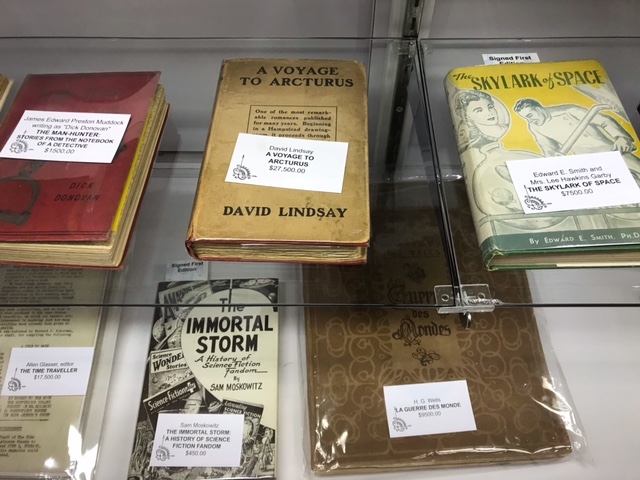
asking a mere $27,500 for A Voyage to Arcturus

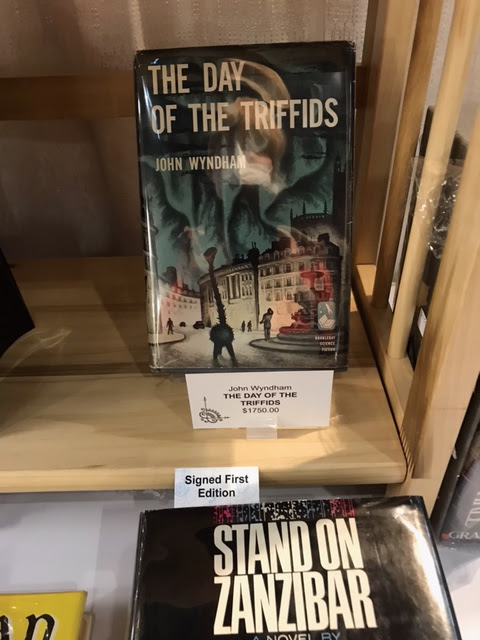
The Day of the Triffids is practically being given away at $1,750

Geometria et Perspectiva, 1567:
if you have to ask, you can't afford it 

When wandering among the stalls, it's easy to forget that you're in the Armory; one's attention is inevitably drawn to the well-lit stalls and all the commodities and commotion at ground-level.  But I looked up as we were exiting.

The balcony reminds me of Shakespeare, though it was not in fact
used in any of the productions I've seen at the Armory

The screening on the way in was perfunctory, presumably focused on making sure we weren't trying to exercise any Second Amendment rights.  Once inside, security guards were always nearby, often sitting unobtrusively, and I'm sure there were many cameras.  Most vendors, even those with extraordinary items, allowed people to go in to their stall and peer closely through the glass at their wares; those with less valuable books sometimes had bookshelves for browsing.  A very few arranged their stalls in a manner to subtly suggest that only serious purchasers were welcome to approach.  On my way out, I was grateful that the only book I'd brought with me was a paperback of The Song of Roland in poor condition with prominent orange highlighting from a previous owner.  The security guard readily accepted my claim of ownership.

Monday, June 26, 2023

Home and Not-Home

This year's Mythmoot was a bit strange for me.   Partly, this has to do with various crises in the background at home and at work, the worries I couldn't leave behind.  And I'm very acutely aware that I haven't been doing any sort of academic writing in the last few years, consistent with a feeling (or a fear) that I have nothing to say.  Then again, the "homeward bound" theme, though certainly 100% appropriate as we returned to the National Conference Center, didn't seem to prompt truly compelling topics, even among those who have plenty to say.  And of course there was the constant undercurrent of an insider's recent ouster; a reminder that this is no longer the scrappy up-and-comer defying the odds.  Even worse, we learned over the weekend that we would not be able to see Verlyn, as she was convalescing. 


However, the bacon was plentiful, and the company was good, and I got to spend some time with SGGK.  


The "Dream Team" of Tom, Joe, and Alan were again victorious in the pub quiz -- pretty much guaranteed when two-thirds of the questions were on Tolkien! -- so our household will be enriched in due course by a book or two purchased with an Amazon gift card.    


I got to chat a while with Brenton's wife Chrissie, who had gotten lost in the maze of corridors, and with Tara, who had found her way easily (doubtless drawing on deeply embedded memories of Mythmoots past).   


In the course of a hazy and humid stroll around the grounds, I saw a deer, a cardinal, and a bright blue bird of some kind (but not a bluejay). 


Abrams, who outbid me on An Anthology of Beowulf Criticism (ed. by Lewis E. Nicholson), very generously gave it to me and (alas!) refused compensation.  If I ever part with the book, he gets first dibs.  On the way home, Tom had me read the first paragraph of each essay but Tolkien's aloud to him while he was driving; whether for this reason or another, a Great Drowsiness came upon him and I soon found myself in the driver's seat for the final stage of the journey.

I was not driving when I took this picture

Thursday, June 08, 2023

My First-Ever Corsi-Rosenthal Box!

So, I ordered all the materials to make my own C-R box way back in the first week of 2022.  And I enthusiastically shared the instructions on social media.  But I also bought two commercially available air purifiers for use in my home -- nice and compact -- and just never got around to making the C-R box.  After all, I wasn't really going to get COVID at home, was I?  (I'm far more likely to be exposed than my spouse, and I generally mask up in public indoor spaces, esp. subways, restrooms, elevators.)

Enter June 2023, with wildfires raging in Canada.  Tuesday evening, I noticed the strange quality of the light on the way home from the subway... and a slight acrid smell at home, as if something had burned.  I didn't think much of it.  But Wednesday morning was much worse, and over the course of the day the sky darkened to a dull, dystopian glow.  And at home, our air filters didn't seem quite up to their task.  I was uneasy about it, but it wasn't until late at night that it occurred to me -- why not?

So I did it this morning, at long last!  It ain't pretty, but I'm proud of it.


Monday, May 29, 2023

Bobance and Bounce

In chapter 5 of The Silver Chair, Puddleglum assures the children he will join on them on what he sees as their grim and hopeless quest:

I'm not going to lose an opportunity like this.  It will do me good.  They all say -- I mean, the other wiggles all say -- that I'm too flighty; don't take life seriously enough.  If they've said it once, they've said it a thousand times. 'Puddleglum,' they've said, 'you're altogether too full of bobance and bounce and high spirits.  You've got to learn that life isn't all fricasseed frogs and eel pie.  You want something to sober you down a bit.  We're only saying it for your own good, Puddleglum.'  That's what they say.  (Lewis 75-76)

From this use of bobance, bounce, and high spirits, I had the impression that the three words were connected.  After all, bounce suggests physical energy -- a natural result of high spirits.  And to my mind, partly from context and partly from the sound of the word, bobance suggested a sort of buoyant cheerfulness, in mood and/or energy.   

I first got an inkling of my misjudgment from the opening passage of Sir Gawain and the Green Knight (ll. 8-10):

Fro riche Romulus to Rome ricchis hym swyþe; 
With gret bobbaunce þat burȝe he biges vpon fyrst,
& neuenes hit his aune nome, as hit now hat;

[From the time noble Romulus swiftly directs himself to Rome;
With great bobbaunce that city he establishes first,
& names it his own name, as it now has;] 

So what is bobance/bobbaunce, then?  The OED advises the word is Obsolete, apparently overlooking its use in a 1953 children's book that has remained continually in print ever since.  Starting with the glossaries provided with the poem:

  • SGGK, 1940 Early English Text Society edition: "bobbaunce, boast, 9; OF. bobance" (Gollancz 137)
  • SGGK, Tolkien/Gordon second edition: "bobbaunce n. pomp, pride 9. [OFr. boba(u)nce.]" (Davis 167)
The sole meaning the OED provides for the singular form is: "Boasting, pride, pomp."  The five references offered range from c1380 to a1533.  One is from the poem Cleanness: "Bobaunce & bost & bolnande priyde."  Another is from Chaucer's Wife of Bath's Prologue, though I'd note that Riverside Chaucer perfunctorily glosses this as "boast" (Chaucer 112).  

Do the other Marsh-Wiggles think Puddleglum is too full of pride/pomp?  Or too full of boasting?  They think he needs to become more serious-minded, to understand that life isn't easy.  I think pride may work better here, but since a person who is too prideful may be prone to boasting, maybe we can hedge our bets and render their remarks as follows:

'Puddleglum, you're altogether too full of boastful pride and bounce and high spirits.  You've got to learn that life isn't all fricasseed frogs and eel pie.  You want something to sober you down a bit.  We're only saying it for your own good, Puddleglum.' 

====

Additional ruminations on OED entries:

Significantly, perhaps, the word bob in the current sense of buoyancy is a relative newcomer.  The oldest senses of the verb (c1320 and c1280) had to do with cheating/deceiving/defrauding and hitting/striking with a fist or a rounded thing.  The first noun form (c1400) involved a knob or cluster, but the sense of trick/deception is attested c1540, and a blow of the fist followed c1566.  

The noun bob, n.4 seems to have emerged around 1550 with a sense of "1. An act of bobbing, or suddenly jerking up and down; a light rebounding movement." (Although the OED provides no attestations for this usage.)

The verb bob, v.3 seems to be first attested around 1568, although the OED finds one dubious earlier reference in Chaucer in 1386. "1a. intransitive. To move up and down like a buoyant body in water, or an elastic body on land"

====

"bob, n.4." OED Online, Oxford University Press, March 2023, www.oed.com/view/Entry/20791. Accessed 29 May 2023.
"bob, v.3." OED Online, Oxford University Press, March 2023, www.oed.com/view/Entry/20801. Accessed 29 May 2023.
"bobance, n." OED Online, Oxford University Press, March 2023, www.oed.com/view/Entry/20811. Accessed 29 May 2023.
Chaucer, Geoffrey, and Larry Dean Benson. The Riverside Chaucer. 3. ed., [Nachdr.], Oxford Univ. Press, 2006.
Davis, Norman, editor. Sir Gawain and the Green Knight, Edited by J.R.R. Tolkien and E.V. Gordon. 2nd ed., Clarendon Press, 1968.
Gollancz, Israel, editor. Sir Gawain and the Green Knight. Oxford University Press, 1940.
Lewis, C. S. The Silver Chair. 1st Harper Trophy ed., HarperTrophy, 2000.

Sunday, May 14, 2023

My 2021 Reading Projects

So, apparently buoyed by the success of my 2020 Shakespeare reading project, I had a modest ambition for 2021: I would read all of Edmund Spenser's The Faerie Queene and finish reading "Sir Gawain and the Green Knight" in middle English.  

I apparently thought I would read one canto per day and dispose of Spenser in 74 days, and thereafter read 79 stanzas of SGGK in 79 days, and then move on to other poetry, such as Tennyson's Idylls of the King.

Well, I did manage to read Idylls of the King in May 2021, so there's that.  And I certainly got a decent start on The Faerie Queene in 2021; I chipped away at it from mid-February to late July.  Then I set Spenser aside, and it was nearly a year and a half before I started again in earnest!  But now, after a two-month push, I am DONE.  

So my initial 74-day estimate was a little off; it took me more than 7 months over a 2.25 year period.

When I recommenced FQ, I also started up with SGGK again as well, so there is some hope that my official 2021 reading project could actually be completed during my lifetime.  


Thursday, January 19, 2023

Nine Years Ago Today...

LEE'S MYTH:  So this is apparently the kind of morning when a simple attempt to make a fried egg turns into Popcorn for Breakfast. Let my biographers make of it what they will.

FRIEND: On the mostly cloudy winter morning of Jan. 19, 2014, LEE'S MYTH went into her kitchen as whimsical as always. Instead of making a fried egg, which was a staple for the first and important meal of the day back in those days, she made popcorn. Little did she know it heralded the dawn of a new era. By 2050, popcorn was considered the breakfast of champions.

LEE'S MYTH: Hahaha! That is awesome. FRIEND, you are now my official authorized biographer. 😉

LEE'S MYTH: (Unfortunately, the real story involves an element of horror - an egg with a Black Yolk and the stench of Mordor....)

FRIEND:  This authorized biographer has the next 40 years to improve her writing:)

LEE'S MYTH: And I guess I have 40 more years to come up with some achievement that will justify a full-length biography.... Hmm, no pressure, right? 🙂

* * *

So far, as of January 2023, it's looking like I may have to hire my own biographers if I want even a cheesy biographical pamphlet.  But there are two more Mordor-adjacent incidents to report since 2014.  

2017: Ungoliant visited during a brief warm spell in February and sank her fangs into our tree:


2022: A batch of cookies was thwarted by the Black Yolk of Mordor.


Friday, July 29, 2022

Frog-Talk: Βρεκεκεκὲξ κοὰξ κοάξ

Apropos of nothing, I made a note of this in October 2017: Brekekekèx-koàx-koáx / Βρεκεκεκὲξ κοὰξ κοάξ

Thursday, July 28, 2022

The Beech-Grove

After Sam and Frodo are rescued from Mordor, they awaken in a beech-grove in Ithilien.  We enter the scene with Sam's return to consciousness:

(LotR VI.4 at 951).*  After some discussion and their morning ablutions, Frodo and Sam follow Gandalf "out of the beech-grove in which they had lain" even further into a world of bliss and beauty and abundance (id. at 952).

* * *

So here we see peace and safety associated with a bed outdoors in a beech-grove.  We say "safe as houses," but the description here really emphasizes the lack of roof.  With no roof and no walls, the hobbits would necessarily be exposed to the elements, wouldn't they?  No doubt the clement weather, too, is a sign of grace. 


FN* Sam quickly realizes where he is (that smell!) and verifies that Frodo is sleeping peacefully.  Over the next five paragraphs he has a bit of conversation with Gandalf and springs out of bed, before we (along with Sam) learn that Frodo first woke up hours before ("I was awake early this morning, and now it must be nearly noon.").  


Wednesday, July 27, 2022

Lewis Carroll's Games and Puzzles

I used to have a paperback book devoted to various brain teasers by Lewis Carroll, which I foolishly jettisoned when it started disintegrating and have never been able to find again after many online searches.  I associate it with the place we lived in 1986-1991, so it was probably published no later than that (quite possibly much earlier) and seem to recall it was edited by Martin Gardiner.  It may have been published by Penguin.  And yes, I have used some and all of those search elements and more (including quotes from specific rhymes and puzzles I remember from inside the book) to no avail.

One of the games this book introduced me to is a thing where you are to change one word into another in a certain number of steps, changing one letter at a time - and of course, each step must be a word. 

For example, the challenge might be to change DROP into PAIL, which can be done in 6 steps as follows:
DROP
DRIP
GRIP
GRIN
GAIN
PAIN
PAIL

(It may be possible to do it in fewer than six steps, that's just what it took me!)  This is a game I've played sometimes on the subway for fun, setting myself the odd semi-random challenge; ideally there is some connection between the words.

Other examples I generated, as a possible exercise for the reader: 

  • change HAND into FOOT (5 steps or fewer)
  • change NOSE into EARS (5 steps or fewer)
  • change BALD into HAIR (4 steps or fewer)
  • change NOSE into TOES (4 steps or fewer)
  • change COOL into WARM (5 steps or fewer)
  • change SHOE into SOCK (this took me 10 steps - surely it can be improved upon!)
  • change MIND into MUSH (5 steps or fewer)


Elvis Is Everywhere and Other Pre-Pandemic Miscellany (2019)

  • The song could so easily have been "Elves Is Everywhere" – Sam Gamgee's theme song – and it could have had the refrain "Elves needs boats, Elves needs boats" (thus explaining the Bermuda Triangle in the process).  We will not speak of the Lórien bots, although that has its own charm.
  • The calls to legalize marijuana now always provoke this thought in me: "...because there isn't nearly enough carelessness, incompetence, and sloppy thinking."
  • Doesn't the Ursula K Le Guin book (on which a friend's cat is sleeping) look like the The Tombs of Tuan? I like to think of Túan as the undead offspring of Tevildo and Húan.  And that might explain why the cat isn't helping...
  • Thinking of S, who died far too soon:
    • She loved wearing overalls, for pretty much the same reason her beloved hated them (they are unflatteringly unisex and juvenile)
    • Overall, she had a sort of modesty or humility that seemed to reflect a lack of confidence, or even a discomfort with her own gifts (which were many).  
      • When she was in grad school, there was a guy in her program who kept telling her "I'm in love!"  She would keep asking him who with, and he would keep replying "With life!"  It was obvious to me and everyone else that he had a crush on her, but she seemed to take his statement at face value and found it very inspirational.  (She was very surprised and chagrined when he finally confessed that she was the object of his affection.) 
      • When we were in high school or early college, I remember my dad mentioning once that she'd sent him her resume; he told me he was willing to speak with her, but she'd have to reach out to him.  Why didn't I tell her that?  (She never did reach out to him.)  
    • She was given to almost naive enthusiasms, perhaps even self-consciously reveling in her own unabashedness, while she could be quite scornful of enthusiasms she didn't share.
    • She had no patience with posers/wannabes.
    • I remember several quirks about her beloved, including that he deleted the Minesweeper game on her computer because he couldn't resist playing it.  But they were devoted to each other, and I believe were quite happy together.

Perelandra & Theological Debate

I have in my notes a response to some superficial/snarky characterization of the fact that Ransom ultimately takes his "debate" with the Un-man to the physical plane in Perelandra.   (As best I can reconstruct it, the claim must have been that Lewis seems to suggest that Christianity cannot be defended by logic and reason, but only by physical violence.)   I've adapted my thoughts here for sharing.

===

Preliminarily, I would acknowledge that few believers of any faith are capable of winning philosophical debates with outsiders in real life. 

That said, Ransom is never really engaged in a philosophical debate with the Un-man; both of them are addressing their arguments to the Lady, and the purpose is to create or prevent a Fall on her planet.  Critically, they are not discussing or debating Christianity, which has absolutely no relevance to unfallen Perelandra.  Indeed, Ransom believes that a Fall on Perelandra would prompt divine grace in some terrifyingly different, unimaginable form.†

Rather, the Un-man is looking to tempt the Lady to rebel against Maleldil, and it is not limiting itself to logic and reason.  Appeals to emotion and self-image are entirely fair game.  For example, at one point, the Un-man starts telling seemingly interminable stories which Ransom eventually realizes are designed to play on the Lady's altruism and nobility of spirit to trigger dangerous pride or vanity.  The Un-man seeks to manipulate the Lady by any means available.

Ransom is playing defense.  He is trying to expose and guard against the Un-man's temptations and thus prevent a new Fall.  But he simply cannot win the contest for persuasion of the Lady, because he's human.  He, unlike the diabolical agent animating the Un-man, needs food and sleep, and has only a few decades' experience to draw on.

I would also note that the Un-man literally can't be bothered to debate Ransom.  It doesn't need to persuade him of anything, so it's perfectly content to torment him by repeating his name incessantly at intervals for no reason.*  This passage from chapter 10 explains the peculiar relationship between the Un-man and rationality itself:  

[The Un-man] showed plenty of subtlety and intelligence when talking to the Lady; but Ransom soon perceived that it regarded intelligence simply and solely as a weapon, which it had no more wish to employ in its off-duty hours than a soldier has to do bayonet practice when he is on leave.  Thought was for it a device necessary to certain ends, but thought in itself did not interest it.  It assumed reason as externally and inorganically as it had assumed Weston's body.  The moment the Lady was out of sight it seemed to relapse. 

===

FN† From chapter 11: 

If [Ransom] now failed, this world also would hereafter be redeemed.  If he were not the ransom, Another would be.  Yet nothing was ever repeated.  Not a second crucifixion: perhaps--who knows--not even a second Incarnation . . . some act of even more appalling love, some glory of yet deeper humility.  For he had seen already how the pattern grows and how from each world it sprouts into the next through some other dimension.  The small external evil which Satan had done in Malacandra was only as a line: the deeper evil he had done in Earth was as a square: if Venus fell, her evil would be a cube – her Redemption beyond conceiving.  Yet redeemed she would be. 

FN* Luckily for readers, Lewis explains the concept in a few pages rather than reporting the entire monologue journalistically.

Saturday, June 18, 2022

Back to Cold Spring!

It was a cool, breezy day, perfect for hiking.  For the stem of the lollipop (about 1 hour), I walked from the station to the trailhead, then took a left at the initial fork for the gentle slope of Cornish (blue) to Brook (red).  The loop portion took me about 2.5 hours: right on Undercliff (yellow), left on Washburn (white) to go up and over the top of Bull Hill, then left on Notch (blue) back to the junction with Undercliff.  From there, I retraced my steps.  

Not much to report in terms of flora or fauna, but it was nice to get back to the old stomping grounds.  


Saturday, May 21, 2022

Nosiness

At the AskAManager site: 

1. How do I explain why I’m not donating blood?

My medium-sized company is hosting a blood drive on site in a few weeks and HR has really been pushing for people to sign up. I would love to donate blood but because I am a sexually active gay man, I am not allowed. Because I live in a small, conservative town, I am in mostly in the closet (totally at work). My employer is basically the only game in town and I need to keep my job. From past conversations and experiences, I have no doubt that things would not go well if I came out (that includes HR and my boss).

While I hate that this is how it is, I have come to terms with it. The issue is, I don’t know what to say to people when they ask why I haven’t signed up. I can’t say the truth so I think a small white lie is the way to go. I was going to say that I donated recently already but as this is a small town, we don’t have many drives so worry about follow-up questions. Any other suggestions? 

Since I apparently missed the commenting window, here's my $0.02:

I'd try to pick a vague reason or even a non-reason and repeat it over and over, no matter what.  Unless the busybodies have a subpoena, you don't have to give them a real answer of any kind - no matter how hard they push.  

And if they start speculating about specific reasons why you might be unable to give blood, whether correctly or incorrectly, I'd move to "You are not entitled to that information."  Or "Wow, that's presumptuous."  Or just stare at them in amazement at their rudeness and walk away.    

I suppose the bottom line, for me, is that it is, in fact, the busybodies who are being rude if they persist after a polite non-answer or a polite deflection.  The longer they persist, the ruder they are being.  You owe them nothing.

And now that I think about it, the letter writer doesn't even need to reveal the fact that he cannot give blood.  If he's got the courage to face down social disapproval and is willing to ignore or deflect attempts to persuade him that he's being selfish or insufficiently public-spirited, "I don't want to" is a more than sufficient reason - and it should shut down inquiry into his reasons.  

Sunday, October 17, 2021

Along Breakneck Ridge

So today, I took the high road and stayed along the ridge.  It was more arduous than I remembered; there's a bit of scramble which feels a little exposed, especially when the wind gusts, and there was a lot of mud and damp leaves.  On the final leg, I managed to stray from the official path and had a punishingly steep descent.  Felt it in my knees after a while - not good.  

But it was a good day overall.  Plenty of fungi and flowers.  Not much wildlife - just a daddy long-legs, a few slugs, and a worm or two.  


Arrived Cold Spring at 10:30, made it to the 4:04 train at Beacon.

Tuesday, October 12, 2021

Answering Back to a Gaslighter

Another pair of moments when perhaps Tolkien and Lewis are exploring similar ideas in their fiction. 

The setup for both, broadly speaking, is that a villain has dominated another's will through nefarious means.  With the assistance of outsiders, the victim is starting to break free, and the villain turns to gaslighting.  A person once under the villain's dominion now answers back.

In "The King of the Golden Hall" (LotR bk III, ch 6), Wormtongue's steady lies and evil counsel over a period of years have managed to sap Théoden's strength until he sees himself as a doddering old man.  Gandalf breaks the "spell" with a little sound-and-light show that leaves the cowardly Wormtongue face down on the floor, then gives Théoden a solo pep talk and encourages him to remember and re-embrace his own strength by casting aside his staff and holding a sword.  Théoden is soon ready to hear the news (the need for action to protect his people) and reacts to it as a king should.  When Wormtongue is brought back, he tries to salvage the situation with a little gaslighting:

'Dear lord!' cried Wormtongue. 'It is as I feared. This wizard has bewitched you. Are none to be left to defend the Golden Hall of your fathers, and all your treasure? None to guard the Lord of the Mark?'

'If this is bewitchment,' said Théoden, 'it seems to me more wholesome than your whisperings. Your leechcraft ere long would have had me walking on all fours like a beast. [...]' 

So the ploy doesn't work; the erstwhile victim has come to see things clearly.  But note the form of response.  He doesn't flat-out contradict Wormtongue.  He shies away ever-so-slightly from the direct confrontation by taking Wormtongue's premise as possibly or hypothetically true, and choosing Gandalf's way over Wormtongue's way as "more wholesome," even if magic is involved.

Lewis tackles something a bit like this in "The Queen of Underland" (The Silver Chair, ch. 12).  An evil witch has kidnapped and bewitched Prince Rilian of Narnia, giving him amnesia so that he will fall in with her plans.  She has had him in her power for years.  Puddleglum and the children free Rilian during one of his brief moments of lucidity, and he smashes the instrument of his magical enslavement.  The witch returns, and quickly creates a new enchantment to cloud the thinking of Rilian and his rescuers, while she works to gaslight them into believing that her dreary underground caves are the only reality.  

She deflects and denies all their attempts to "prove" (or get her to acknowledge) the existence of the sunlit world they have always known, half-persuading them that they have invented or dreamed it all.  So when Puddleglum finally manages to break this new enchantment, he does not try to reject the witch's false premises. Instead, he takes them as at least presumptively true and explains why he chooses the ways of Narnia and Aslan over the witch's way even if they are mere illusions. 

"Suppose we have only dreamed, or made up, all those things – trees and grass and sun and moon and stars and Aslan himself.   Suppose we have.  Then all I can say is that, in that case, the made-up things seem a good deal more important than the real ones.  Suppose this black pit of a kingdom of yours is the only world.  Well, it strikes me as a pretty poor one. And that's a funny thing, when you come to think of it.  We're just babies making up a game, if you're right.  But four babies playing a game can make a play-world which licks your real world hollow.  That's why I'm going to stand by the play-world.  I'm on Aslan's side even if there isn't any Aslan to lead it.  I'm going to live as like a Narnian as I can even if there isn't any Narnia.  So, thanking you kindly for our supper, if these two gentlemen and the young lady are ready, we're leaving your court at once and setting out in the dark to spend our lives looking for Overland.  Not that our lives will be very long, I should think; but that's a small loss if the world's as dull a place as you say."  

 (italics in original; bold added) 


Friday, October 08, 2021

Good But Dangerous

In the popular imagination, labeling a person as "good" can be a way to dismiss them.  The playground taunts of someone as a "goody-goody" or a "goody two-shoes" imply that they are over-scrupulous or even over-concerned with the appearance of goodness as if to curry favor with those in power.  The stereotype is perhaps to say that a "good" person is an obedient rule-follower, boring and insipid, lacking in imagination and drive; they are predictable and easily taken advantage of.  They will surely finish last.  Indeed, there can be something almost offensive in their seeming inoffensiveness. 

But Lewis and Tolkien, each in their own way, decouple the ideas of goodness and safety in their fiction – both naturally and implicitly in the worlds they have created, and also expressly in reported dialogue.  


Here the Beavers are telling Peter, Susan, and Lucy about Aslan (whom we have not yet met) in chapter 8 of The Lion, the Witch and the Wardrobe (emphasis added):

"Ooh!" said Susan, "I'd thought he was a man. Is he – quite safe? I shall feel rather nervous about meeting a lion."

"That you will, dearie, and no mistake," said Mrs. Beaver; "if there's anyone who can appear before Aslan without their knees knocking, they're either braver than most or else just silly." 

"Then he isn't safe?" said Lucy. 

"Safe?" said Mr. Beaver; "don't you hear what Mrs. Beaver tells you? Who said anything about safe? 'Course he isn't safe. But he's good. He's the King, I tell you."

(The idea comes back in various forms throughout the Narnia books.  In The Silver Chair, for example, Jill Pole asks Aslan to "promise not to – do anything" to her, if she comes and drinks from the stream; he declines, and proceeds to tell her "I have swallowed up girls and boys, women and men, kings and emperors, cities and realms."  We repeatedly hear that Aslan is not "a tame lion.")


And here's where Gandalf tells Aragorn, Legolas and Gimli about Fangorn, in book III, chapter 5 of The Lord of The Rings (emphasis added):

"But you speak of him as if he was a friend.  I thought Fangorn was dangerous."  

"Dangerous!" cried Gandalf. "And so am I, very dangerous: more dangerous than anything you will ever meet[...].  And Aragorn is dangerous, and Legolas is dangerous. You are beset with dangers, Gimli son of Glóin; for you are dangerous yourself, in your own fashion. Certainly the forest is perilous [...] and Fangorn himself, he is perilous too; yet he is wise and kindly nonetheless."