We go to the wildlife refuge every time we come down here, but typically stay on the main drive and the primary offshoots (like the mangrove overlook and the cross-dike area). So I hadn't been on the Indigo Trail in years. It is a wide unpaved bike path, just two miles of sand and crushed shell to take you back to the entrance of the refuge without doing the full loop on the main drive.
My dad and I decided to bike out for a short loop yesterday, crossing over to the bike path so we'd make it back in time for dinner and
Hamlet {solo}.
I was biking ahead, a little before the half-way point on the Indigo Trail, when my dad called to me. I turned back and a low-flying flash of bright red (apparently a bird) crossed the path from west to east. But my dad's attention was focused on the embankment on the west side of the path. It was an alligator. It seemed almost sculpted from stone, sitting still on the slope, sunk in the grasses:
 |
| I'd biked right by the gator, but my dad saw the glint of its eye. (Several other groups of bikers and pedestrians had also apparently passed it without noticing anything.) |
We kept a respectful distance and photographed it mostly from the side -- rather than, for example, from in front of its jaws. The eyes never blinked, and the gator never moved while we watched. It was slightly unnerving to be so close to it with no real barrier between us. Probably we could "outrun" it on our rusty old bikes, in a pinch - but we really didn't want to find out.
A bit further on, we noticed that behind the exterior barrier of mangroves and underbrush, there was an interior rank of mangroves which was covered with white birds (probably ibises). When we got to an opening, we saw a tree with five roseate spoonbills and a few ibises on it. One spoonbill was grooming itself in a very photogenic way, the bill clearly visible in front and fluffing its darkest pink feathers. Unfortunately, I couldn't focus my camera on the tree due to the young mangroves in front.
I had slightly better luck capturing their reflections:
Next up was a very nice new observation walkway/platform, from which we were able to see ibises, anhingas, and ducks.
 |
| Observing the observer |
A bit fuzzy, but the scene was very cute:
 |
| Fuzzy ducks (for Suzie) |
It has been more than a year since Suzie died. I don't recall if she ever joined us here (I know Becky did), but I am sure she would have loved it. Every time I saw duck-like waterfowl, I thought of her. It also called to mind our high school gang's catch-phrase: "Wanna buy a duck?" "Does it quack?" "Of course it quacks; it's a duck!" Perhaps a mini-reunion is in order for 2014, to be hosted here.
Today, we came back and brought my mom. We tried to keep our expectations low for the walk up 1.5 miles along the bike trail and back again... but we were really hoping for another gator sighting (and, on my part, for more roseate spoonbills).
At the observatory, we saw more herons, ibises, anhingas, and ducks.
 |
| Grooming |
 |
| Immature ibis |
 |
| More waterfowl |
 |
| Female anhinga |
 |
| Two waterfowl among the mangroves |
 |
| Little blue heron |
The roseate spoonbill tree was again bedecked with roseate spoonbills and ibises (hooray!).
And... we spotted an alligator
in the water! Again on the west side of the bike path, but about a mile further south than yesterday.
 |
| It appeared to be 8 feet long |
We could not tell if it was the same alligator as yesterday. It's possible that this one
might have been bigger/older, but we just don't know enough to say for sure. (In any event, I felt safer because there were trees and underbrush between it and us.)
In any event, we watched for a while, and it eventually submerged a bit, re-emerged, and turned around (away from us) to face the bank of an interior island or delta in the river. This is when we were able to see its full length. On the far side of the interior island were many ibises; we were wondering whether the gator was hoping they would stray toward his waiting jaws, or whether the gator was gearing up for a hunting foray. The gator seemed to be settled in for the moment, so we finally proceeded on our way.
 |
| Large circles created by the mangrove roots and their reflections |
 |
| You know the area is really closed when there's a cactus barrier |
A little after 5 p.m., we heard a rustling in the mangroves behind us on the west side and turned around to look. Out came an otter, up out of the foliage and onto the bike path!
It crossed the path and went down the embankment toward the water on the east side.
Then (to our surprise and delight) the otter came back up again to hang out on the bike path. As always, we kept a respectful distance... but we couldn't stop smiling.

That's when I took this video:
The sand and crushed shell must be good for an itchy back!

I caught a short video of it scrambling back down to the water (not shown), and then another short video of it swimming away:
This was the first time I've seen a river otter in the wild - and I've been to this wildlife refuge many, many times over the years.
We saw a few birds flying low over the bike path as it grew dark, and my mom and I even glimpsed an osprey flying low over the path in front of us, carrying a large fish in its claws - that was pretty cool.
We went on to the 1.5 mile mark (and verified the location of yesterday's gator sighting) without further incident, and then turned around. The return trip went very quickly.
 |
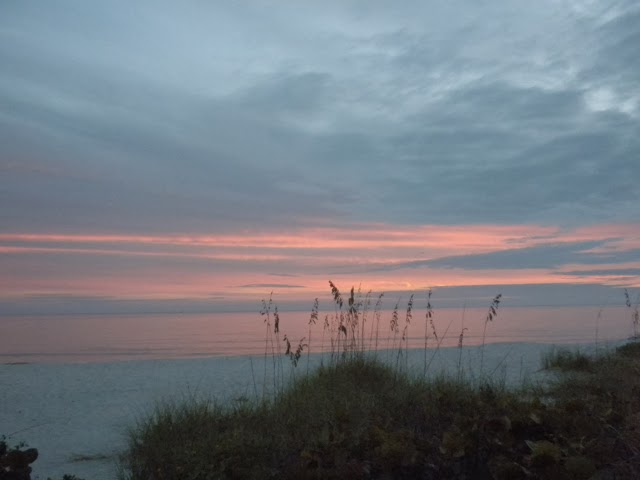
| Sunset |
We felt very fortunate.