Sunday, December 18, 2005

The Lion, The Witch & The Wardrobe (2005)

Since LWW brings us into the realm of fantasy (i.e., the land of Narnia, populated with talking horses and beavers, etc.), I thought I'd start with horses on Park Avenue in Manhattan....

Just as with the Harry Potter movie adaptations, people have been saying that LWW is very faithful (or perhaps "too faithful") to the original source material.

Me, I spot a lot of differences -- most of them appropriate to fill out the screen, but some changing the message in significant ways.

To those who think LWW can be enjoyed without awareness of the Christian allegory, I agree on one level (after all, I was entirely unaware of it the first time I read the book), but I wonder: What would someone who was entirely unfamiliar with the Christ story make of the fact that a big lion gets killed and then comes back to life, and this somehow saves the life of an undeserving boy and brings an end to a grim 100 years of winter? In a cultural vacuum, I'd think that particular plot development would seem a bizarre detour away from the narrative thread. LWW is by no means a perfect allegory, but it was clearly intended to soften kids up for the underlying concept behind Christianity.

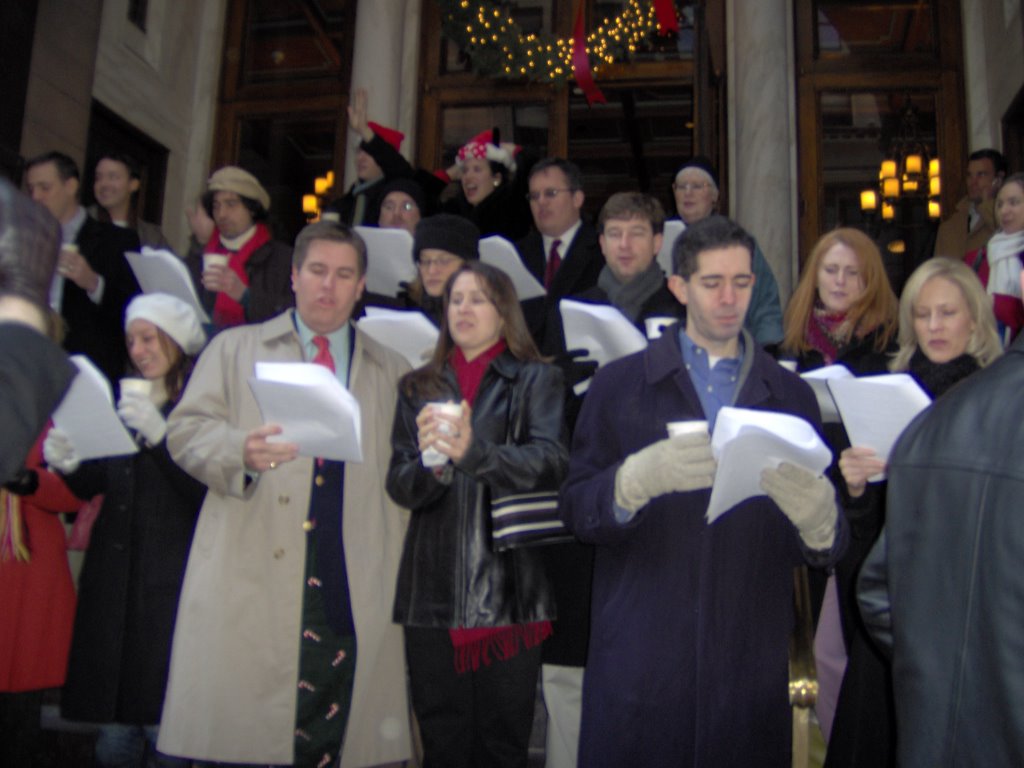
(Speaking which, here are some Christmas carolers on the steps of Fifth Avenue Presbyterian Church. We are renowned for our energy and enthusiasm, if not for our vocal range. The crowd favorite this year was "Frosty the Snowman.")

That said, LWW was really cute and a lot of fun. Some nice touches -- for instance, starting in London during the Blitz (where Edmund risks everyone's life in a mad dash back into the house to retrieve a picture of his dad ... a point which is echoed nicely when Edmund & Co. visit Mr. Tumnus's ransacked home, and Edmund's eyes are drawn to the portrait of Mr. Tumnus's father - on the floor, cracked).

Saturday, December 17, 2005

Blues

To what extent is it the job that is soul-sucking, as opposed to the attitude one brings to the job? And when is the sensation of deadening properly diagnosed as a form of protective fear (e.g., protection from the fear of not being up to the challenges ahead ... or the fear of infusing a job one does not care about with things one does care about)?

We moved overseas when I was almost 12, and had begun to experience gnawing adolescent self-doubt. So I leaped at the chance to start over in a new place. But these new anxieties and doubts were not (as I thought) connected with my external circumstances; they were not in any way emanating from my close-knit group of elementary school friends. Because these worries were generated from within, they proved to be entirely portable. They followed me across the Atlantic and back again, more powerful than before because I dared not name them or confront them. (After all, if you have some deep failing or inadequacy, or some undefined and imperceptible rottenness in the core, your only hope is to conceal it and hope no one catches on...right?)

There are times when the discrepancy between self-perception and objective reality is so strong that an outsider cannot really believe it. The only answer, the only solution has to be what Tim Keller referred to as "blessed self-forgetfulness". And the question has to be how, or perhaps the question is what must one focus on to put everything else (including one's goodself, as the Trinidadians say) in proper perspective?

Thursday, December 08, 2005

Defending the Neighborhood

There are surprisingly more defenses to Prospect Park (the "526-acre urban oasis located in the heart of Brooklyn, New York City's most populous borough") than you might otherwise imagine.

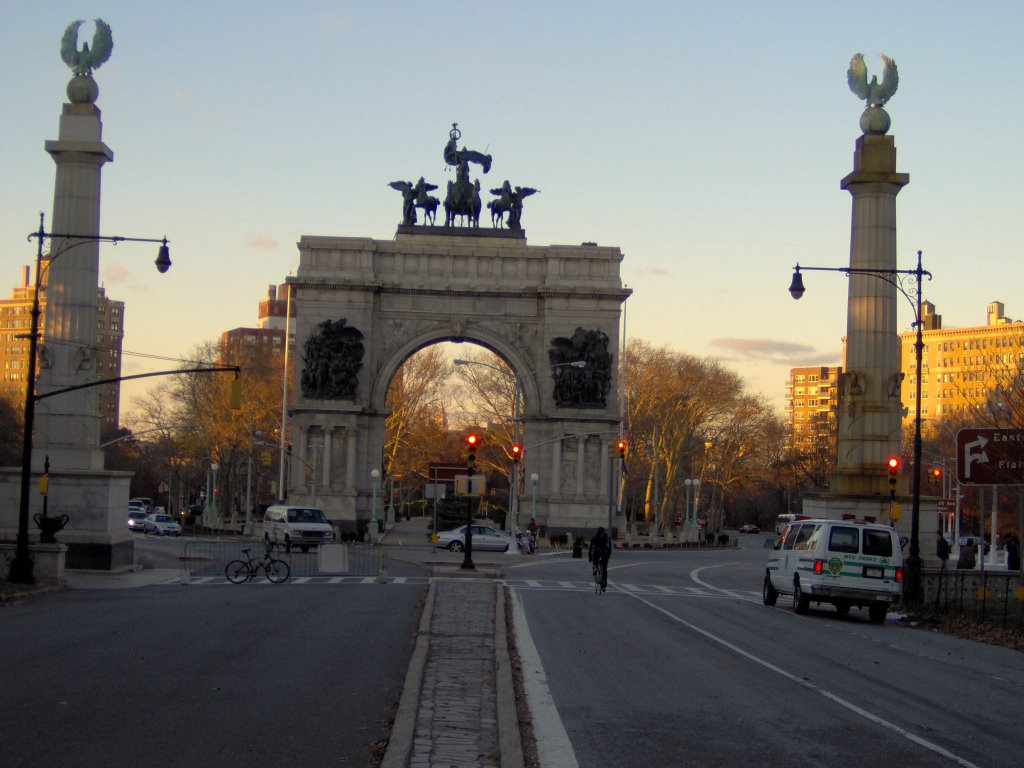
Invaders from Manhattan must first cross Grand Army Plaza. (One of two Grand Army Plazas in the city, oddly enough. The other is at the southeastern corner of Central Park. Those copycats!) Darkening your path is a menacing arch overlooking the northern end of the Park, adorned with "heroic Civil War battle scenes attended by Greco-Roman mythological figures".

Seven stories above street level, the lady Columbia (representing the United States) rides in a war chariot with winged Victory figures trumpeting her arrival. She is flanked by "The Spirit of the Army" and "The Spirit of the Navy", which "depict frenzied scenes of soldiers amid unwavering officers charging through the chaos". Intimidating indeed (at least when there's not a farmers' market set up at their feet).

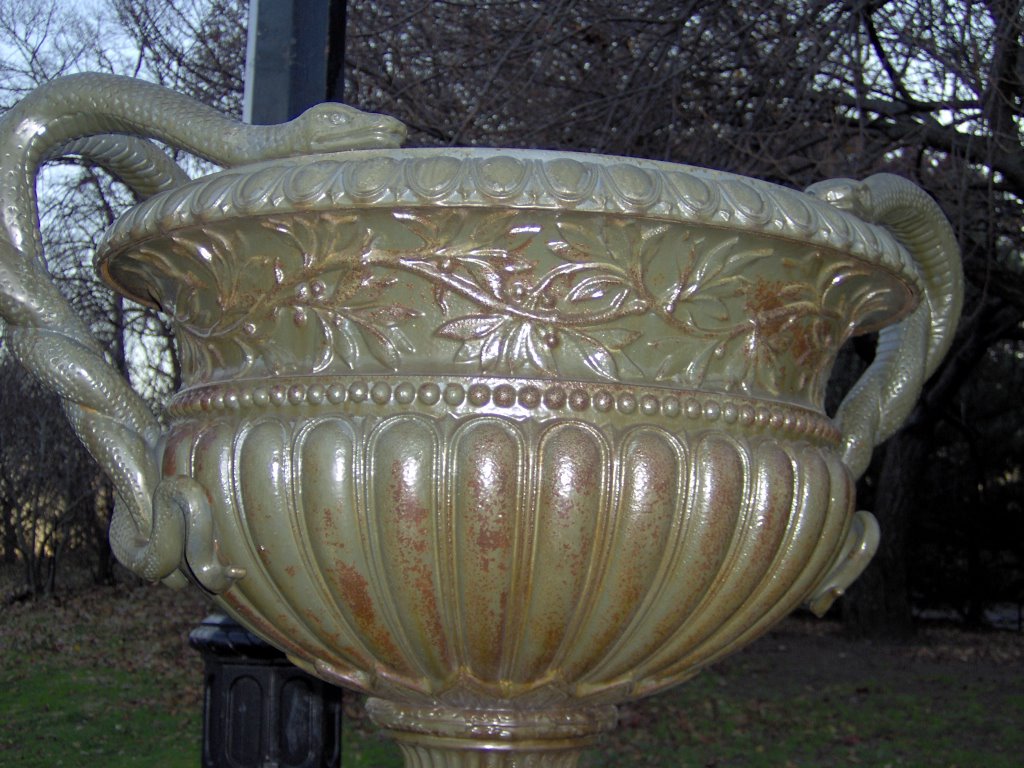
As you cross in front of the arch with its chariots of war, the entrance to the Park is flanked by urns with snakes on the handles. So if you are affiliated with Gryffondor or Hufflepuff or Ravenclaw -- rather than Slytherin -- watch out.

I suppose the more optimistic interpretation would be that in this Eden, we keep the snakes on the outside of the Park.

(If the reference to Hufflepuff baffles you, check out JK Rowling's web site. It's pretty cool, with fun facts, and interactive hidden clues and puzzles that give you access to some of her early drafts and drawings. Plus there is a mysterious door which opens at times to reveal hints about what's in store for Harry, a matter of great debate on mugglenet.com and other fan sites.)

There is also a cool guard tower, although I have yet to find any name or description of it anywhere.


So why all the security? Clearly to protect treasures such as Harmony Playground, and to defend Prospect Park's skating rink, zoo, chess & checkers area, carousel, and other delights (which I fear may have been shamelessly copied off of Central Park by the omnipresent Olmstead) from hordes of barbarians from the other boroughs.


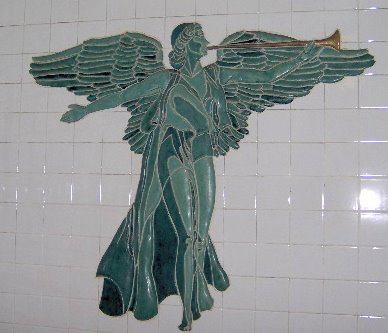
Those leaving Grand Army Plaza, however, travel peacefully under the benevolent gaze of the angel of the IRT. (She is blowing her trumpet in the direction that subway-goers must travel as they descend to the tracks.)

Friday, December 02, 2005

Reflections on "Prisoner of Narnia"

The 11/21/05 issue of The New Yorker includes an essay by Adam Gopnik entitled "Prisoner of Narnia" (pp. 88-93). It's an interesting piece -- the arguments are largely made by means of derogatory adjectives rather than by logic, reason, or evidence.

For me, the general tenor of the essay is shown by Gopnik's choice of analogies. I noticed two in the essay. He compares Oxford dons to "girls in a lap-dance club" (p. 90) ... because both allegedly adopt personas that are caricatures of themselves to help them deal with other people. And he compares Christians to "chronic sinus sufferers" (p. 92) ... because both allegedly compare notes on the state of something that interests them. I have stated these propositions as neutrally as I can so that readers may judge for themselves the usefulness of the analogies. It looks to me like the analogies were chosen mostly as a means to associate Oxford dons with sleaziness and Christians with sick people, but perhaps they were chosen just to show Gopnik's cleverness in finding similarities between wildly dissimilar groups.

After carefully reading the essay, I believe many of Gopnik's claims are unsupported, or miss the point entirely, or are just plain wrong. (Some of this is fairly subtle - Gopnik is right, of course, that C.S. Lewis was never a saint; but the point he is trying to make would be a hell of a lot more persuasive if he showed that C.S. Lewis's behavior stayed the same or got worse after his conversion.)

In this post, I will address a few of Gopnik's claims.

"Keep your belief going, no matter what it takes" (p. 92)

Gopnik states: "A startling thing in Lewis's letters to other believers is how much energy and practical advice is dispensed about how to keep your [sic] belief going.... Keep your belief going, no matter what it takes -- the thought not occurring that a belief that needs this much work to believe in isn't really a belief but a very strong desire to believe." (p. 92)

There is no need to be "startled" by Lewis's emphasis on the importance of maintaining one's faith, as Lewis's point is rather more nuanced than Gopnik lets on. In fact, Chapter 11 of Lewis's book Mere Christianity addresses this point directly.

Lewis did not take the position that one must maintain one's belief "no matter what" -- to the contrary, he expressly recognized that "if [a person] thought the evidence bad but forced himself to believe in spite of it, that would be merely stupid." And a person whose "reason once decide[d] that the weight of the evidence is for [Christianity]" must reconsider the evidence if "any real new reasons against Christianity turn up." Contrary and inconvenient evidence cannot be ignored, but "ha[s] to be faced."

So what must a believer's faith be defended against? Lewis's answer may be a bit shocking to people who have accepted a cartoonish version of Christianity (equally prevalent in children's Sunday school classes and in the media): Lewis states that "The battle is between faith and reason on the one side and emotion and imagination on the other." I find two of Lewis's examples intriguing.
"For example, my reason is perfectly convinced by good evidence that anaesthetics do not smother me and that properly trained surgeons do not start operating until I am unconscious. But that does not alter the fact that when they have me down on the table and clap their horrible mask over my face, a mere childish panic begins inside me. I start thinking I am going to choke, and I am afraid they will start cutting me up before I am properly under. In other words, I lose my faith in anaesthetics. It is not reason that is taking away my faith: to the contrary, my faith is based on reason."
"Or take a boy learning to swim. His reason knows perfectly well that an unsupported human body will not necessarily sink in water: he has seen dozens of people float and swim. But the whole question is whether he will be able to go on believing this when the instructor takes away his hand and leaves him unsupported in the water -- or whether he will suddenly cease to believe it and get in a fright and go down."
C.S. Lewis, Mere Christianity, Chapter 11.

Lewis is not the only one to have noticed this phenomenon, either. Phil Keoghan (the force behind the television show The Amazing Race) describes his experience finding himself lost and alone in a shipwreck when scuba diving at 19 (with another scuba diver and a camera crew nearby who knew he was somewhere in the wreck):
I was riding a kind of emotional seesaw: One moment I was up high, reassuring myself that "it's okay, someone will show up soon, just stay calm." The next moment, I felt myself descending to the bottom of the seesaw, the dark side where reason gives way to panic, and where doubt ("How do you know anyone's coming back?") overrides faith.

Phil Keoghan, No Opportunity Wasted, Chapter 1. (Keoghan notes that doubt and panic ultimately triumphed in his case - ironically, that stresses the air respirator system and depletes one's air supply more rapidly - and that he soon slipped into unconsciousness. He was nonetheless rescued and returned with a new zest for life, a drive to make every moment count.)

"Aslan the lion, the Christ symbol, ... is ... in many ways an anti-Christian figure" (p. 92)

Gopnik does raise an interesting point about differences between Aslan and Jesus Christ. He notes, correctly, that Aslan comes in power and glory as the king of the beasts and "the top of the food chain" rather than in humility. (p. 92) He further posits that "[i]f we had, say, a donkey ... rallying the mice and rats and weasels and vultures and all the other unclean aminmals, and then being killed by the lions in as humiliating a manner as possible -- a donkey who reemerges, to the shock even of his disciples and devotees, as the king of all creation, now that would be a Christian allegory." (Id. (emphasis in original))

This argument proves too much. Obviously any comparison (including Gopnik's own colorful analogies as well as Lewis's Christian allegory) contains points of similarity but also points of difference -- otherwise it would not be a comparison but a mere reiteration.

The redemption scenario in The Lion, the Witch and the Wardrobe is not directly parallel to the Christian story. It is not meant to be. For instance, Aslan dies for just one sinner (Edmund) rather than for the whole world, and Aslan's sacrifice is apparently a secret (it is not clear that Edmund ever learns of it; only Lucy and Susan see Aslan's humiliation, suffering and death, and Susan's view that "[i]t would be too awful for [Edmund]" if he were told of it prevails). (ch. 17) I am not sure why Lewis made these choices, except that it may be easier for children to grasp the concept of Christian sacrifice writ small (for one person who has clearly done something terribly wrong) rather than going into the more complex Christian concept that all of us -- even "good" people -- are sinners desperately in need of redemption.

So, why did Lewis make Aslan a powerful lion rather than a humble donkey? Well, why stop there? If we take Gopnik's argument a little further, perhaps Lewis should have made Aslan a mouse, or a cockroach, or a speck of dust? By exaggerating (and yes, mocking) Gopnik's point we can see some of the reasons why Lewis chose a lion.

For instance, making Alsan a lion emphasizes the extent of the sacrifice Aslan made for Edmund: the humiliation of a proud and powerful lion is more likely to evoke pity and horror in children than the humiliation of a donkey (or a mouse or cockroach, for that matter). Presumably Lewis wanted children to like and admire Aslan so that his death would have more impact.

There is perhaps a more subtle point here as well. A typically Christian view is that (i) God is the rightful sovereign of the universe and (ii) the entire trinity (father, son and holy spirit) consitutes just one God (not three separate gods). So it makes sense to make the Christ figure a lion -- widely considered the "king of the beasts" -- in order to emphasize that he is the rightful sovereign of Narnia ... even though the evil one has claimed the crown. Lewis chose to emphasize the glory of God; as Kathy Keller has noted, there is certainly biblical precedent for this. [Updated 3/8/2015 to remove non-functional link.  Her article is currently available at http://www.redeemer.com/redeemer-report/archive-pdfs, go to "2005 Newsletters" and select "December 2005."]

The Narnia stories are racist (p. 88)

With apparent approval, Gopnik notes in passing that "the wonderful British fantasist Philip Pullman has excorciated [the Narnia stories'] racism (the ogres are dark-skinned and almond-eyed)". (p. 88) Gopnik does not marshal any further evidence for or against this point in the rest of the article, leaving Pullman's charge to dangle before the reader without analysis.

If it is evidence of racial bias that the evil ogres are "dark-skinned and almond-eyed" (there is no citation for this point, but we will assume for the moment that this description is actually found somewhere in the Chronicles of Narnia), then it can surely be disproved by a showing either that (i) some dark-skinned characters in the Narnia stories are good or (ii) some light-skinned characters are evil.

As it turns out, we need look no further than The Lion, the Witch and the Wardrobe to disprove the charge:
  • The most evil character in the book (the devil figure, if you will) is the person who has set herself up as "Queen of Narnia" in Aslan's absence. Here is how she is described: "Her face was white -- not merely pale, but white like snow or paper or icing-sugar, except for her very red mouth." (ch. 3) So the race of the most evil character is unmistakably Caucasian.
  • And what of the other side -- what does good look like in Narnia? Well, Aslan is (like all lions) "golden" in color (e.g., ch. 12), which somewhat defies categorization in terms of human racial characteristics. But it is perhaps worth noting that as good starts to triumph over evil, "[i]nstead of all that deadly white the courtyard was now a blaze of colors; glossy chestnut sides of centaurs, indigo horns of unicorns, dazzling plumage of birds, reddy-brown of foxes, dogs and satyrs, yellow stockings and crimson hoods of dwarfs; and the birch-girls in silver, and the beech-girls in fresh, transparent green, and the larch-girls in green so bright that it was almost yellow." (ch. 16)
In fact, when good is ascendant in Narnia, there is tremendous, jubilant diversity, a veritable riot of both color and sound (like a Gay Pride parade without the eroticism). The Narnians, once liberated, are running, dancing, cavorting, shouting, singing, and laughing with joy. (ch. 16)

I fear it is not Narnia that is "nasty" and "narrow-hearted" in this regard (p. 88), but rather our friend Pullman.

Monday, November 28, 2005

The Triumph of Legal Realism?

Apparently the facade of the U.S. Supreme Court has begun to crumble - literally. First Harriet Miers, and now this. The legal realists are undoubtedly dancing in the aisles, but it's a sad day for the rest of us.

Saturday, November 26, 2005

Thanksgiving

My family and I enjoyed the mild weather and sunshine of southwest Florida for Thanksgiving, as we have done for most of the past 27 years.


We no longer drive down every year from the midwest (that stopped 22 years ago when we moved overseas), but instead fly in from our respective cities. These days, as a New York resident, I suppose I'm actually the "southerner" in my nuclear family -- my parents keep drifting north. Considering their current residence selection criteria, the only suitable location north of them would be Alaska. I can't see that happening; my mom would hate to live so far away from her grandchild. (My sister-in-law's parents have nine grandchildren, and my mom was taken aback to see that they included a picture of "her" grandchild - since she has only one - along with the rest of them in their holiday cards last year. Seemed a bit greedy, or something. I pointed out that if my parents wanted nine grandchildren, they should have had five kids. You take your chances if you have just two kids.)

As always, a highlight of the trip was biking around the island -- there are wonderfully extensive bike paths throughout.


We are roughly in the middle of the island, so you can bike 5 miles one direction to a lighthouse, or 5 miles in the other direction to the Ding Darling National Wildlife Refuge. There are plenty of mangroves.


Many years ago, a supposed naturalist/guide told me that mangroves absorb radiation, so the mangrove forest would be the best place to be in the event of a nuclear holocaust. However, I've never been able to confirm his claim that mangroves somehow protect you from radiation. I still like mangroves though.

On this trip, we saw a crocodile (meaner looking than the more common alligator).


Later, in the Bailey Tract (a small nature preserve with ponds, set up for short walks and nature observation), we saw moor hens and a woodpecker, as well as a rabbit which might end up as an alligator's meal.


Pools are always fun for the kids. For instance my 18-month old niece loves to swim. Of course, this love has not really been put to the test -- we do all the work of holding her up and moving her along the surface of the water (it's great arm exercise) while she gleefully splashes with her feet.


The light is lovely and transformative. You can see the water glimmering in the harsh afternoon sun...


... and then everything becomes silky and softened in the twilight.


We enjoyed beautiful sunsets.


On my last night, I couldn't sleep. So at 3 am I went out to the beach and looked at the stars for a while. I even saw one shooting star -- nothing like the display in November 2001, but still.... "Every star shining brightly /Just like a million years before /And we were feeling very small /Underneath the universe."

I am so grateful for all these things.

Saturday, November 19, 2005

Bittersweet

After catching the latest Harry Potter flick on Friday night, I spent Saturday with a friend from Michigan, whom I've not seen for a while. We munched on bagels in Prospect Park, then headed for the Brooklyn Botanical Garden.

Soon after you enter the garden, you pass through some trellises wound about with gnarled vines:


The trellises were pretty cool; here's a better perspective.


Surprisingly, a few roses were in bloom. We didn't pick any of the flowers, though.


The Powers That Be at the garden decided that the maples that were planted in 1917 were at the end of their useful life, so they recently ripped them all out and planted red oaks - lovely at this time of year.


The new trees were dedicated to the victims of 9/11 (i.e., they are no longer commemorating WWI), and someone went through the trouble of painting American flags on small stones and placing them around the base of each tree.


Some trees, though barren of leaves, were festive with berries.


The Japanese Hill and Pond Garden is a meditative spot, espcially at this time of year without the crowds.


The "celebrity walk" near the Japanese Hill and Pond Garden features famous Brooklynites. Some are formerly famous - sic transit gloria mundi.
Maurice Sendak has his own star, er, leaf, which is well-deserved.
I've read several of Sendak's books, including his most popular work Where the Wild Things Are, and a few books written by others but illustrated by him in his inimitable style - including the witty etiquette guide for children, What Do You Say, Dear? (Sample scenario: "You are a pilot flying a plane, and you remember that your friend the princess has invited you to drop in some time. So you do." -- Next page shows the pilot has literally dropped in through the roof, frightening the princess and her dog: "What do you say, dear?" -- Next page: "I'm sorry." And the drawing shows that the breach of etiquette has been forgiven in light of the courteous apology.)

I have also seen Sendak in person, in interviews at the Met and at Fairley Dickenson, and luckily caught the Sendak exhibit at The Jewish Museum in Manhattan. All of these things have increased my respect for Sendak as an artist and as a person.

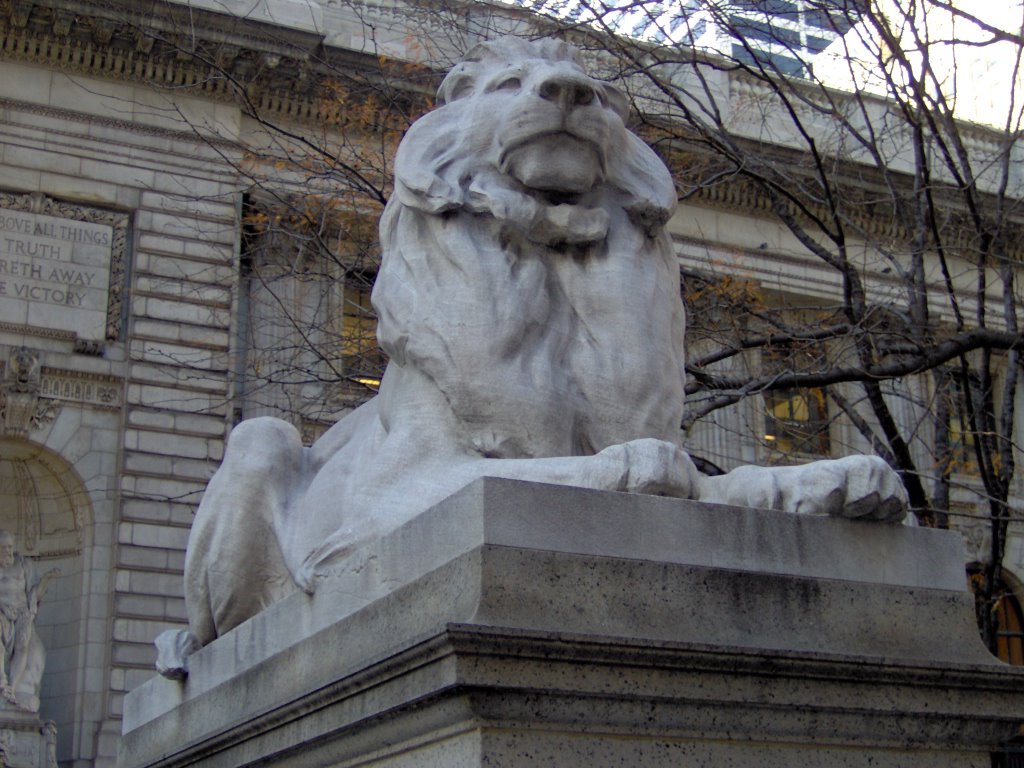
We visited the HQ of the New York Public Library (serving only Manhattan, the Bronx, and Staten Island -- Brooklyn and Queens have their own independent library systems). Rumor has it that the NYPL is even bigger than the Detroit Public Library.


Instead of visiting the cadaver exhibit, we ended up at the Transit Museum, which was somewhat less macabre and (presumably) much more hands-on. You even can pose for pictures that make it look like you are driving a bus -- although I settled for this period picture instead.


It was good to wander around Brooklyn and Manhattan together; we laughed a lot and were quite tired by the end of the day.

Saturday, November 12, 2005

Hiking the Wilds of the Garden State

At the last minute, I was able to join up with some friends and nature-loving Redeemerites for an expedition into the wilds of New Jersey, led by our fearless leader Bruce (not to be confused with his fellow Garden Stater, Bruce Springsteen, or his perhaps distant ancestor, Robert the Bruce).

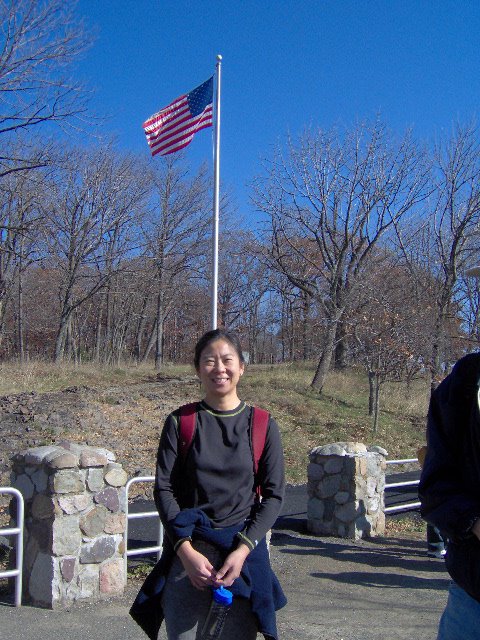
I thought I would know just one person on the hike, Patricia. Instead, I knew four people -- and one person remembered me from a retreat in July 2003. Very impressive memory, Joyce! She remembered my name AND some facts about me (e.g., I'm a mahjong buff). Here is Joyce, immortalized in a photograph so that the next time we run into each other I will hopefully remember her as well. This was our first scenic overlook on the hike, but I gave her a patriotic backdrop instead of a fall foliage backdrop:


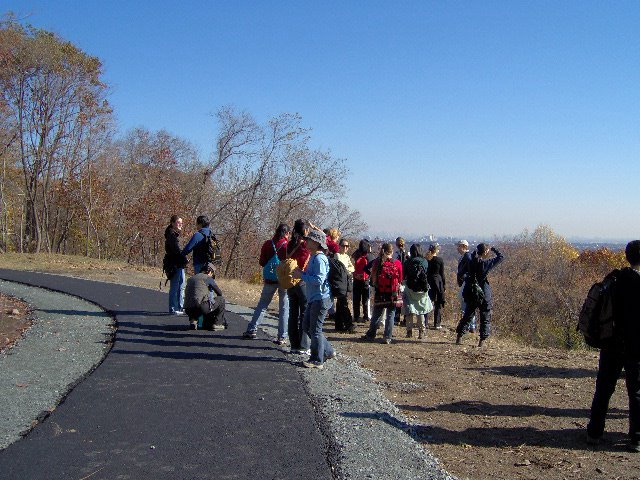
From that first lookout point, we could just barely see NYC through the haze. Or maybe it wasn't really smog, it was just realllllly far away. From Millburn, NJ. Right. The picture came out pretty well though:


Here's the whole gang -- a good turnout of 22 people at the time this picture was taken, although I guess you can't really see everyone in the picture because it was an unposed, totally candid shot with people blocking each other and wandering out of the frame. (Of course, with a group of New Yorkers that large, it took a while for us all to get ready -- everyone was buying coffee, etc. -- and then even once we started, we moved very slowly. I believe the technical term for the sort of hiking we were doing was "moseying." We went so slowly, that Alda's friend who overslept and caught the next train an hour later was able to catch up with us, raising our number to 23.)


You may have noticed something funny about the ground in that last photo: it was paved. That's right folks, after a brief walk through the woods, we quickly found a paved road to follow to the scenic overlook. This made several of my friends very happy. They were disappointed when we returned to the forest to begin the real 5 mile hike through the woods.

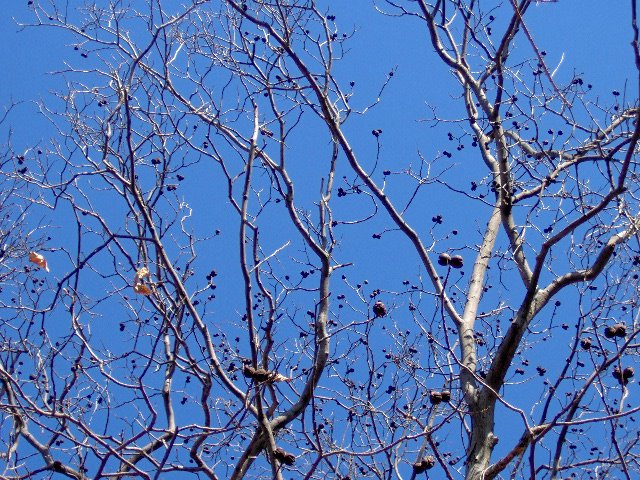
It was a beautiful late fall day, perfect for hiking. About half the trees had lost their leaves already, but this one was nicely silhouetted against the sky -- note the bulbous seed pods:


As we marched on, I saw an interesting fungus growing on the side of a tree. It looked like it was made of wax -- or maybe like one of those fake plaster wall sconces you can buy for an ersatz classic look. I didn't try eating any of it:


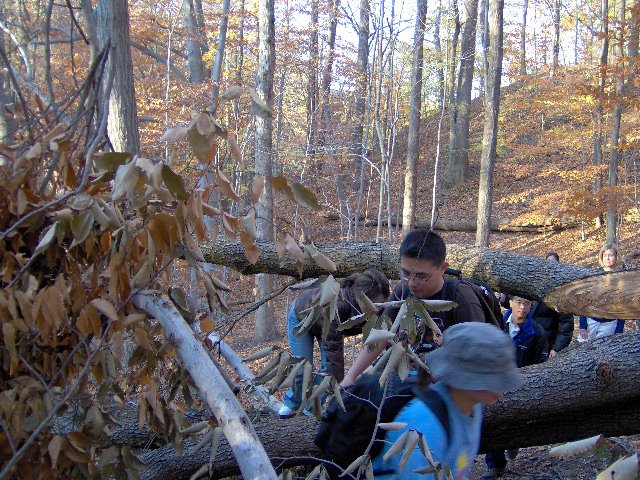
The city folks' yen for pavement may have reached its apex at this point, when the way forward was totally blocked by two toppled trees. Yes, we had to climb over and through, and I'm happy to report that everyone made it. But not everyone was happy about it; New Yorkers don't really like obstacles. We want instant gratification! (Can't we have fresh country air and the exhilaration of a hike without spending four hours out in the country and getting a workout?).


Hopefullly even the complainers enjoyed this nice waterfall. It was not exactly a raging torrent, but it was pretty.


Here is a sample of the lovely fall foliage we saw on roughly half the trees - I love seeing the sun shine through the leaves like this:


We also passed a number of ponds with ducks
and geese

Seven of us dawdled afterward and enjoyed some tea and light supper at the local diner, then three of us peeled off to catch the 4:56 train back to civilization (not that we were ever out of earshot of the sound of traffic, but what do you expect when you are a few train stops away from NYC).

Afterward, I caught The Weatherman with Nicholas Cage. (No, I didn't see it with him; he was just starring in the movie.) There were some funny moments, and some positive developments over the course of the movie - particularly the fact that the hero actually learns a useful new skill, archery - but overall, it was a bit of a downer. Plus the story line with the son didn't really seem to go anywhere; what exactly was the point of including the son character at all?

Sunday, November 06, 2005

The Call of the Digital Camera

Well, I have learned the hard way that I can't count on friends and relatives to (a) take pictures of everything that needs to be memorialized and (b) send me the pictures afterward. Not to name any names, but the parents of a certain niece who shall not be named would do well to upload their darned pictures already and email them to a certain aunt.

But I digress. My point is: Welcome to Brooklyn! Now that I finally gave in and got my own digital camera, here's a brief photo tour.

All you ecologists out there, take heart. A tree does, in fact, grow in Brooklyn. Okay, this one may not literally be growing at the moment since its leaves have already turned color in preparation for winter.


Here's another one for our skeptical Michigan friends who do not believe that, as compared with certain inhospitable northern climes, NYC is essentially in the tropics. You will note that as of November 6, the leaves are still entirely green. Amateur botanists confirm that this specimen is not any variety of coniferous tree known in the vernacular as "evergreen". To the contrary, it is an oak tree, known primarily for its propensity to drop copious numbers of acorns and to change its leaves directly from vibrant green to dull boring brown.


This next one is also a scene from Brooklyn. Note the palm fronds sticking out from the terrace. A palm tree grows in Brooklyn too, it seems, and this is outside in November.


That's it for now. In the immortal words of Bill Watterson, "Further bulletins as events warrant."

Thursday, November 03, 2005

The Color Purple (Broadway 2005)

I had no intention of ever watching the musical The Color Purple.

For one thing, I typically hate musicals. I dislike the standard plot, which revolves around people making it in show biz. And for some reason I really dislike the usual "big Broadway sound," which is powerful but somehow hollow/tinny to my ear.

For another thing, much as I admire Oprah Winfrey (one of the producers of the musical and sure to be a key to its success if she promotes it on her show... or in her magazine... or on her TV station... or on her web site... or any other part of her empire), I have to say that I've seen a few scenes from the movie and found it extraordinarily tedious and unwatchable.

So of course when invited to see the musical, I end up agreeing to go.

The show is far more gospel-y than I expected (which is both good and bad), but it is really well done and entertaining. Act I is generally better than Act II, but even Act II has its redeeming qualities -- for instance, there is a wonderful duet called "Is there anything I can do for you?" which is sung by two spouses who have finished their chores and just can't wait to get busy. The jubilant scenes set in Africa in Act II are pretty cool too.

Well, the whole gang loved it (me, my friend, his family, and the rest of the audience). Ho hum, another triumph for Oprah. (Let's just be glad she's using her powers for good instead of evil.) The Color Purple now joins the select few musicals that I've actually liked -- The Lion King, Little Shop of Horrors, The Full Monty, Avenue Q, Frog and Toad, and Sunset Boulevard.