Tuesday, August 05, 2014

Day 4: Avid about Ovid

Black Sea Navigation: BULGARIA: [Nesebar] [Varna] ROMANIA: [Constanţa]
TURKEY: [Sinop] [Bodrum] [Istanbul: Basilica Cistern] [Istanbul: Topkapi] [Istanbul: Haigha Sophia]
GREECE: [Limnos] [Meteora] [Thira] [Athens: Acropolis and Plaka] [Acropolis Museum Highlights]


We had a day in Constanţa, Romania, which just so happens to be the location of Ovid's exile for the last nine years of his life.  It is also apparently the largest port on the Black Sea.  

The on-board lecturer told us Constanţa was the fourth largest port in all of Europe, but there was so little sign of activity on a Tuesday that we thought perhaps he was talking about capacity rather than actual business.  (For what it's worth, I've found the same claim repeated on Romanian tourism websites, whereas wikipedia claims it is the 18th largest port in Europe.)  Whatever its current relative status, however, the port has undoubtedly benefitted from a nearby canal that has linked the Danube to the Black Sea since 1984.

A serene scene at the port


Once we passed through security, we somehow resisted the allure of this particular advertisement (shown here to the right of the text) and made our way out and up toward the Mosaic Museum as originally planned: 

A helpful tourist points out a direction perpendicular
to that which we must travel to exit the secured port area.

A few ruins on the road to the museum.
As usual, it was quite warm and sunny on our long, thirsty walk.  

Cathedral of Saints Peter and Paul

Lovely painted details
Both museums we wanted to go to were right off Ovid's Square, where we found our fearless hero!

Ovid made quite an impression on the gang!
We started with the Mosaic Museum, where the ticket-taker seemed pleased that I spoke to her in French rather than English.  The museum is set up as a big rectangular pit with mosaics in situ on the floor, and a few amphora and miscellaneous architectural bits grouped on one side.  You get to circumnavigate the mosaics on the upper level, and then descend to look at them a bit closer from ground level (windows behind you, as you are facing into the back wall of the former warehouse).   The colors of the mosaics were considerably duller than I'd expected.  I almost wished they'd put a glossy coating on them to bring out the colors and patterns more vibrantly, but I have a funny feeling that perhaps it's not an approved mosaic preservation technique among reputable archaeologists.


Sculptural details on display.


 Amphora!!!


A nearby building, seen from the museum. 
After the Mosaic Museum, the girls were ready to throw in the towel - especially if they could go swimming!!  The grownups wanted to at least take a quick look at the Archaeological Museum, however.  So we came up with a compromise: We would all go to the museum, and one of us would take the girls back to the ship as soon as they found Three Really Cool Things.  

I think the main agitator actually surprised herself by finding three Really Cool Things on display, including a tiny gold coin that had intricate details visible only by magnifying glass.  Her sister, I think, may even have liked the exhibits enough that she might have been willing to stay a bit longer, but a promise is a promise -- so I took them back while more responsible adults continued to peruse the museum.

Really Cool Thing #1 - a grave excavation display set into the floor,
containing "bones of a 2nd-century woman"
I also was interested to see the three-form statues of Hecate, which reminded me of the statues described in Jim Butcher's Skin Game.  (I hadn't realized this was a traditional depiction!  Though of course Butcher's two Hecate statues feature the current queens of summer and winter, respectively.  There is a certain tension in the scene because Michael Carpenter does not know his daughter has become the Winter Lady when he spots the statue of Mother Winter, Queen Mab, and Molly Carpenter.  Harry Dresden quickly lies about this, and luckily a few distractions come up before Michael can pursue this line of questioning.  But I digress.)      

My own favorite item at the Archaeological Museum:
a "sculpture of the snake god Glykon, which is carved from a single block of marble"

The girls and I retraced our steps back to the ship.

The shipyard cranes really reminded me of horses, for some reason.
Black Sea Navigation: BULGARIA: [Nesebar] [Varna] ROMANIA: [Constanţa]
TURKEY: [Sinop] [Bodrum] [Istanbul: Basilica Cistern] [Istanbul: Topkapi] [Istanbul: Haigha Sophia]
GREECE: [Limnos] [Meteora] [Thira] [Athens: Acropolis and Plaka] [Acropolis Museum Highlights]


Monday, August 04, 2014

Day 3: Varna, Bulgaria

Black Sea Navigation: BULGARIA: [Nesebar] [Varna] ROMANIA: [Constanţa]
TURKEY: [Sinop] [Bodrum] [Istanbul: Basilica Cistern] [Istanbul: Topkapi] [Istanbul: Haigha Sophia]
GREECE: [Limnos] [Meteora] [Thira] [Athens: Acropolis and Plaka] [Acropolis Museum Highlights]


First, we visited the Dormition of the Mother of God Cathedral.  They were changing light bulbs inside, but I didn't take any pictures of that.  I liked the outside better, in any event:


At the Varna Archaeological Museum, they had an extensive collection of gold objects, apparently the earliest worked gold artifacts ever found (so far), dating from 4500–4000 BC.  We went around clockwise on the first floor - from the gold exhibit, to pre-history, to Roman influence and beyond (with a nice map of trade routes) - then took a quick look on the second floor, though the air was stifling.

It seems from some of the carved stones on display that Varna repeatedly changed hands peaceably, and chose to welcome their new rulers with a sort of declaration.  As I recall, they always took care to say something like: we really look forward to having you in charge and benefiting from your wise and just leadership; we're so glad you're honoring all our property rights (hint, hint); and "Good luck!"

I particularly liked the "Pre-History" exhibit:

"Anthropomorphous cover, ceramics, lake settlement Arsenala, Late Eneolithic Age"


Here, we seem to have a heart-felt welcome:
When I went around to look at the back, this guy was actually
carved wearing a tool belt, with an adze in it!
As compared with the message here, which might seem to be a rather pointed manner of bidding someone farewell:


The notes I took at the museum read:
Tombstone from 3rd millennium BC, early bronze age
Man’s face with holes
goddess of the late 4500-400 BC
submerged settlement, varna lake
Adze in belt (=tool belt!!)
shoulder blades
This reminded me of a grade-school friend's drawing of the Big Blue Ox
(she had co-starred as that character in a two-hander with another friend as Paul Bunyan)
Black Sea Navigation: BULGARIA: [Nesebar] [Varna] ROMANIA: [Constanţa]
TURKEY: [Sinop] [Bodrum] [Istanbul: Basilica Cistern] [Istanbul: Topkapi] [Istanbul: Haigha Sophia]
GREECE: [Limnos] [Meteora] [Thira] [Athens: Acropolis and Plaka] [Acropolis Museum Highlights]


Sunday, August 03, 2014

Day 2: Bricks in Bulgaria

Black Sea Navigation: BULGARIA: [Nesebar] [Varna] ROMANIA: [Constanţa]
TURKEY: [Sinop] [Bodrum] [Istanbul: Basilica Cistern] [Istanbul: Topkapi] [Istanbul: Haigha Sophia]
GREECE: [Limnos] [Meteora] [Thira] [Athens: Acropolis and Plaka] [Acropolis Museum Highlights]


Our first port of call was Nesebar (aka Nessebar aka Nesebur), Bulgaria.   OK, let's just call it Несебър for simplicity. 

Approaching the shoreline

Always with the boat traffic!!!
We took a tender to the port.

Is the port tender here? 
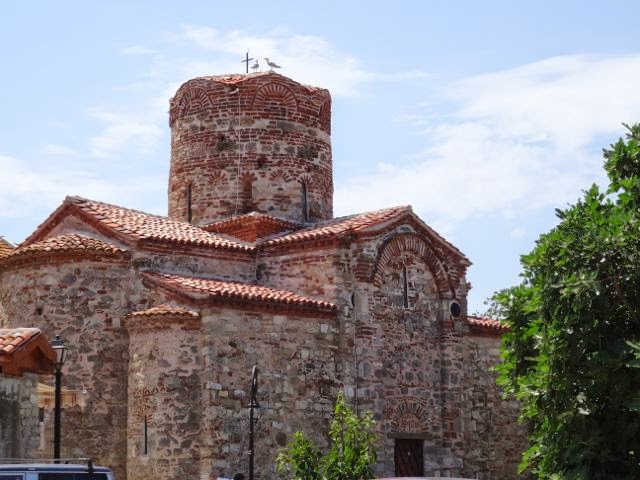
We weren't sure there'd be a lot to see here, so we spent a fair amount of time on St. John's unsanctified church, right by the customs/immigration terminal.


Unfortunately, the tourists have gotten at this one.

Life takes root among the ruins.

An arch!  Definitely not pre-Roman.  


As we wended our way through the streets of the town, we found a lot of places that sell locally made pottery.  My companions picked out some useful and attractive items.  One might have wondered if they were acting too quickly.  After all, this was just the first day -- might there be better items elsewhere?  (Answer: In retrospect, this turned out to be the best place we saw on the entire trip for local crafts! They were wise to act when they did.)


A quaint alleyway

St. Sophia's Church
We looked at (and occasionally entered) a number of old churches.  There were quite a few for such a small town (limited in size by its placement on a peninsula which apparently was formerly an island).
St. Sophia's Church

We went into St Paraskevi Church:
The exhibition arranged in the church is under the title “Surviving murals from lost Nessebar churches”. For the very first time, murals from the lost St George “the Elder” church, destroyed in 1958, are exhibited to the public. The church was built in 1704 in the south-eastern part of Old Nessebar. Most of the retrieved mural paintings were taken to the National Archaeological Institute in Sofia, and only a small part remained in Nessebar. These surviving murals dating to the beginning of the 18th century, along with some wall painting from St Clement church, are the theme of the exhibition.
St. Michael, perhaps?


"The torment of Saint George in prison, St. George 'The Elder' Church, 1704"

Hints of the original decorations survive
(possibly restored) near the front door.

Capital or pedestal?


Ice creams are displayed in elaborate scoop piles
 We went to the archeological museum as well.  I seem to remember a few large stone anchors, some gold jewelry, and a basement exhibit of IKONS.

Oh no!  We're marooned!!!
Black Sea Navigation: BULGARIA: [Nesebar] [Varna] ROMANIA: [Constanţa]
TURKEY: [Sinop] [Bodrum] [Istanbul: Basilica Cistern] [Istanbul: Topkapi] [Istanbul: Haigha Sophia]
GREECE: [Limnos] [Meteora] [Thira] [Athens: Acropolis and Plaka] [Acropolis Museum Highlights]

Saturday, August 02, 2014

Day 1: We set sail!

Black Sea Navigation: BULGARIA: [Nesebar] [Varna] ROMANIA: [Constanţa]
TURKEY: [Sinop] [Bodrum] [Istanbul: Basilica Cistern] [Istanbul: Topkapi] [Istanbul: Haigha Sophia]
GREECE: [Limnos] [Meteora] [Thira] [Athens: Acropolis and Plaka] [Acropolis Museum Highlights]


Important Disclaimer: No sailing was actually undertaken on this particular expedition.

I had expected to have four companions with me as I disembarked for the first time in a majority-Muslim city.  Alas, the airlines treated them to an unexpected multi-stage adventure involving  regions and modes of transportation that were not on the original itinerary, leaving everyone on tenterhooks as to whether and when they would be able to catch up.   

My own travels went quite smoothly.  I'd booked a car in advance, and had a pleasant ride along a road hugging the old walls of Istanbul.  Houses and other buildings were set in and top the apparently crumbling and precarious walls.  It was aesthetically pleasing, and perhaps safer than it looked.  

I arrived at the passenger terminal and went through a passport check and security screening a few hours before they were ready to start processing passengers for the ship.  Gradually, other passengers arrived and also the personnel to process us.  So when the lines died down, I went through another passport screening and security check and went onboard.  

I settled in to a corner table on deck 8 and watched as the skies grew ever more ominous.  At one point, it looked like it might become a tornado.  


The moment quickly passed (that was the best photo I could get of the funnel-shape), but the skies opened up, chasing me further back under the awning.

a mixture of old and new

Hagia Sophia and the Blue Mosque

The Galata Tower

Look ma, I can zoom in on the people!

Dolmabahçe Mosque

Dolmabahçe Palace

An intrepid cruiser

Bosphorus Bridge

Sultanahmet district

Go, pilot, go!


Fatih Sultan Mehmet Bridge & Rumelian Castle

Rumelihisarı (also known as Rumelian Castle)

houses at the base of the bridge


Onlookers

Our motto!!
Black Sea Navigation: BULGARIA: [Nesebar] [Varna] ROMANIA: [Constanţa]
TURKEY: [Sinop] [Bodrum] [Istanbul: Basilica Cistern] [Istanbul: Topkapi] [Istanbul: Haigha Sophia]
GREECE: [Limnos] [Meteora] [Thira] [Athens: Acropolis and Plaka] [Acropolis Museum Highlights]