Sunday, April 22, 2018

Postcards from Paradise


strutting down the branch

 
heron, stalking

Moorhen

gator in log pose


gator in C-pose


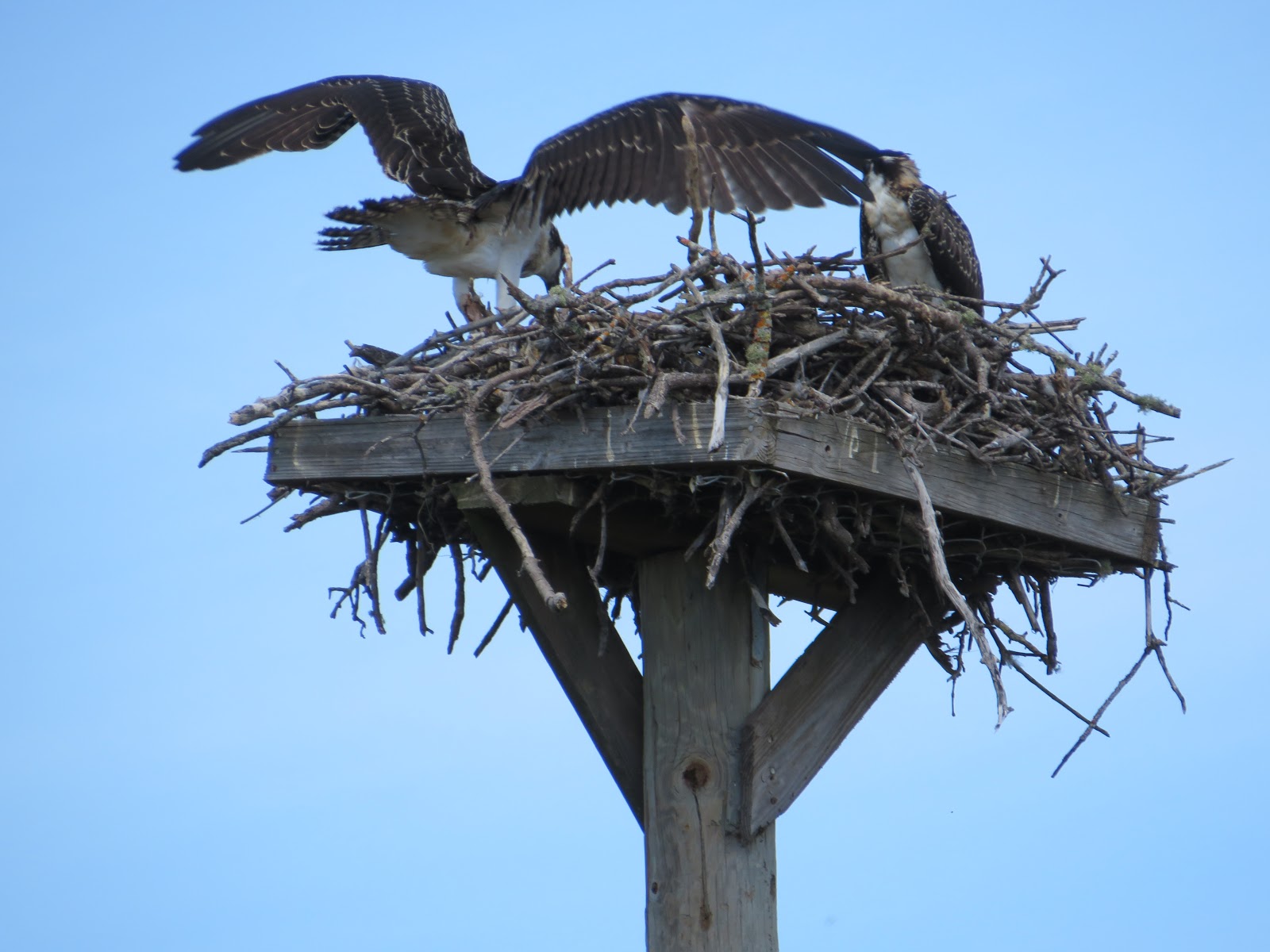
osprey

 
We'd never seen an anhinga nesting before; the blue around the eyes is very striking.  I assume it's special breeding plumage.
female anhinga, nesting


gator tracks


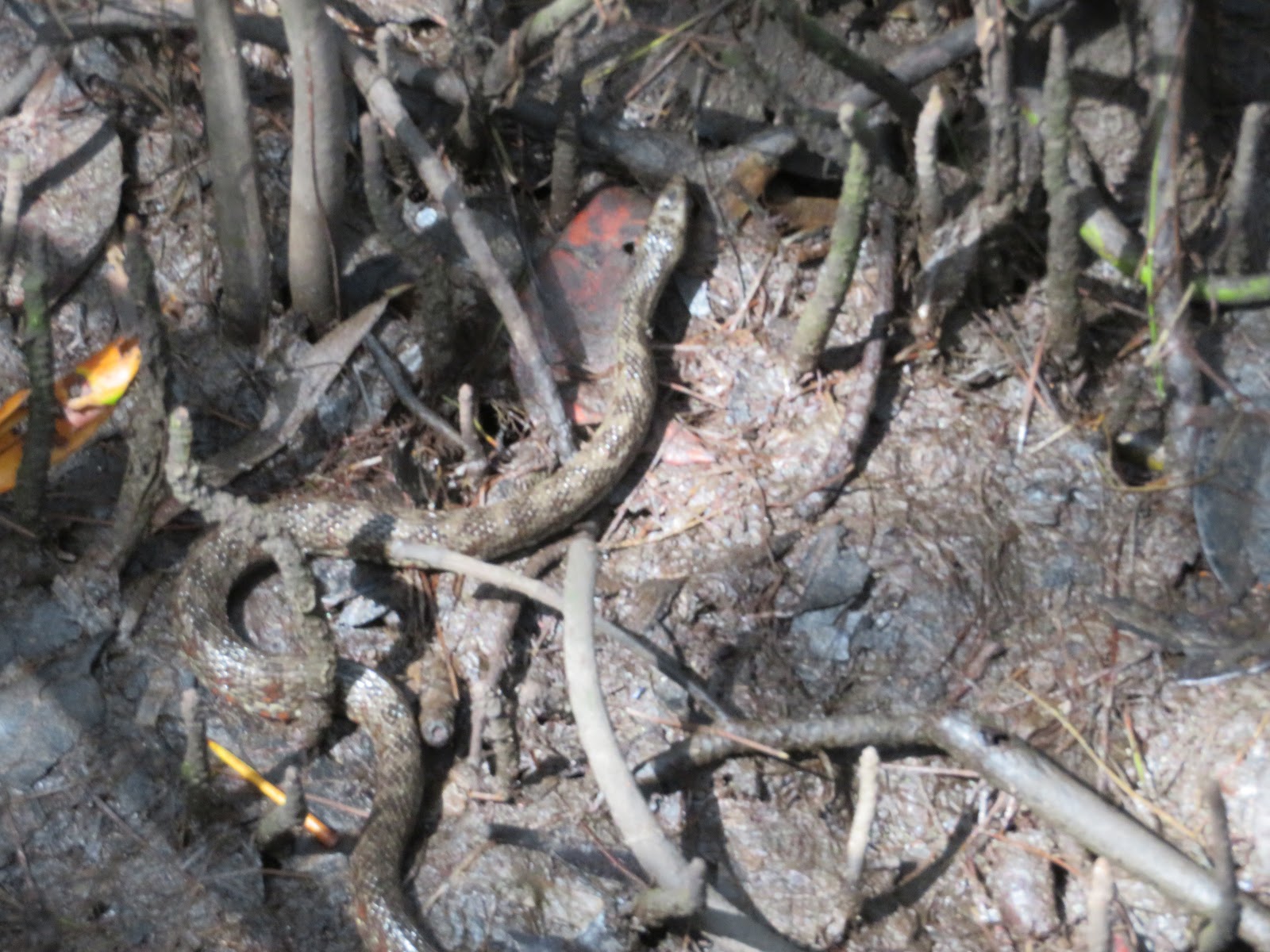
We saw a water snake among the mangrove roots; first swimming, then making its way on the mud in a curiously tentative approach.


orbital spider

reddish egret


pelican


great blue heron
Last night, we saw a civilian boat surrounded by fire and police boats.  It was a little hard to tell in the gloaming, but the roof looked a bit scorched to me. It was still there this morning, so I went gawking.

A Wreck, But Not of the Hesperus


at least it's pelicans overhead, rather than vultures...


starfish and shadow


Wednesday, April 18, 2018

Tolkien and the Diminutive Fairies

Everyone knows that Tolkien strongly disagreed with portrayals of elves and fairies as dainty and little, even though he had initially portrayed them that way in verse.  Tolkien famously disavowed his early fairy-poems late in life, apparently going so far as to claim “I wish the unhappy little thing ['Goblin Feet'], representing all that I came (so soon after) to fervently dislike, could be buried for ever" (BoLT I, at p. 32).*  Indeed, Christopher Tolkien asserts confidently that "all the 'elfin' diminutiveness soon disappeared" (id.)

In his class on Tolkien's poetry, however, Corey Olsen discusses some evidence (including Tolkien's apparent acquiescence to a reprint of "Goblin Feet" five years after its initial publication) that casts doubt on just how quickly this distaste came upon him.

One more piece of evidence about Tolkien's early association of fairies with diminutiveness appears in Roverandom (ed. by Scull & Hammond, 1998, at p. 12):
"His size was not changed, but he was no longer a toy.  [...] He need not beg any more, [...] and he could bark – not toy barks, but real sharp little fairy-dog barks equal to his fairy-dog size."
On the very next page, Psamathos comments on his size ("I don't remember ever having seen another little dog that was quite such a little dog"), but readers have already been fully sensitized to the tininess: as a toy dog, Rover is "so small that going downstairs was almost like jumping off walls" (p. 8) and he fits completely in a little boy's trouser-pocket, above a wadded-up handkerchief (p. 9).

Roverandom seems to have been in development between 1925-37; Scull & Hammond suggest it may have been written down as early as December 1927 (xiii) and that the second of three typescripts was likely prepared for submission to his publishers "towards the end of 1936" (xiv-xv).

So it would seem that at least as late as 1936-37, Tolkien was not sufficiently troubled by the association of fairies with tininess so as to alter or remove this passage suggesting a fairy-dog would be minuscule (cf. xxii ["The text that follows is based on the latest version of Roverandom."]).

"Goblin Feet" was first published in December 1915, and "was reprinted as early as 1920" (Scull & Hammond, Reader's Guide, part 1,  2017, at pp. 457-58).


FN* This particular statement is said to have been made in 1971, in what proved to be the antepenultimate year of his life.  He was, by then, commenting on his views half a century earlier.  

Tuesday, April 17, 2018

Life Hack

In this season, the garden opens at 8 a.m.  Which means I can start my day during the work week by walking through the garden on the way to an express subway stop.  I don't have to miss the beautiful interim stages of bloom, just because I miss a weekend or two!


The weeping cherries are among the very first to bloom...


...although the magnolias are certainly not far behind!

tree with a shadow of petals on an overcast day


Magnolias against Daffodil Hill

Monday, April 09, 2018

King Lear

I saw the RSC's performance of King Lear at a local playhouse this past weekend.  It was well done, of course, and they made some interesting choices.

They went heavy on the pageantry, highlighting the sense of pre-Christian times.  For example, Lear is carried on stage ceremoniously aloft in a large glass box.  He is wearing ostentatiously bulky furs, which set him apart from the others.  Two of his courtiers carry large gilded disks on poles, reminiscent of the moon and sun (although unexplained).  Another courtier holds a crown out sort of near or above Cordelia's head.  Every time Lear curses someone, there is a portentous pause and low percussive sounds punctuate his speech.  When he curses Cordelia and Kent in open court, everyone turns to him, bowing their heads and freezing, as if in terror of his wrath, suggesting his word is absolute.

They tried to humanize the villains, which is certainly supported by the text to some extent.  Edmund does, indeed, suffer through his father's cavalier and jocular description of his conception, and it is surely not the first time.  It works for us to see his reaction (even though it will never justify his amoral ambitions).  But did Edgar, the elder, have to be a man-child who is kicking a ball around with friends indoors?    I think it's effective to show Goneril's and Regan's purported concerns ambiguously supported in the beginning; we should not be entirely sure if they were mostly pretextual ab initio. But here, Goneril is acutely distressed, genuinely anguished, by her father's harsh words and his abusive knights; I think this goes too far.

The glass box was an interesting device, but they pulled it out many times, to diminishing returns.  Having Gloucester blinded inside the box provided a sense of distance which left the scene merely gory, rather than heart-wrenching.  (I was also a little disappointed in the cursory portrayal of First Servant, but that's probably not RSC's fault.*)

I liked Cordelia, and I liked their race-conscious casting.  It gave a general impression of race-blindness, but I think it was actually carefully thought out.  In the opening scene you have white-Gloucester, white-Kent and black-Edmund, leaving the audience to wonder about the role of race here.  (Is there an implication about Edmund's mother's socio-economic class?  Will race be aligned with villainy?)  Then Lear et al. enter.  The various courtiers are white and black.  Lear and his two wicked elder daughters are white; Cordelia is black.  Gloucester and his decent elder son are white; Edmund is black.  Cordelia's suitors are black, and Regan's husband is white, but Goneril has married across racial lines and both sisters go gaga for Edmund.  So overall, there is no clear alignment of virtue, villainy, or victimhood along racial lines:


I enjoyed the piece overall, but it really had only one truly heart-breaking moment.  It comes at the very end, when Albany urges Edgar and Kent to rule the kingdom jointly, and Kent replies:
I have a journey, sir, shortly to go;
My master calls me, I must not say no.
His delivery of these lines was understated and devastating.


FN* “In King Lear (III:vii) there is a man who is such a minor character that Shakespeare has not given him even a name: he is merely 'First Servant.'  All the characters around him – Regan, Cornwall, and Edmund – have fine long-term plans.  They think they know how the story is going to end, and they are quite wrong.  The servant has no such delusions.  He has no notion how the play is going to go.  But he understands the present scene.  He sees an abomination (the blinding of old Gloucester) taking place.  He will not stand it.  His sword is out and pointed at his master’s breast in a moment: then Regan stabs him dead from behind.  That is his whole part: eight lines all told.  But if it were real life and not a play, that is the part it would be best to have acted.”

 – C.S. Lewis, “The World’s Last Night” in The World's Last Night and Other Essays, San Diego, New York, and London: Harcourt, Inc., 1987, at 104-105.

Sunday, April 08, 2018

Bluejays and Cardinals

So, today I tried to do a 15-mile point-to-point walk merely from the trail description (without a map), but backwards.  The first portion was well-marked, but then I got to a point where the directions didn't seem to line up as expected with what I was seeing and I ended up doing a huge, unexpected loop that brought me back to an intersection with the trail I'd come in on.  From there, it was rather demoralizing to backtrack several miles to my starting point (esp. since I'd front-loaded the hike with lots of road walking), but I just couldn't figure out how to get to my intended destination.  My actual ramble was a bit over 11 miles.   The walk itself was not particularly scenic, and it's not ideal to share the trails with cyclists, but some of the walkers were friendly, and overall it was a good excuse to re-listen to the early poetry lectures as inspiration for the final exam.   The highlight for sure was the bird sightings: two cardinals (male and female) and two bluejays.

Got home just in time to try to bring some rusted paint cans to one of the city's disposal events, but when I arrived I could see no sign of them -- I guess they must pack up early so they can make their getaway precisely at 4 pm or possibly a little earlier.


Sunday, April 01, 2018

Fooling around in the Garden

April Fool's Day was quite important to me as a kid.  Like CSL's dwarves in The Last Battle, I prided myself on Not Being Taken In.  So, of course, I was fooled by missing out on a cool bird sighting my brother made one April 1st.  My parents were at first skeptical, but went and checked it out and were delighted.  But I was oh-so-certain (wrongly) that they were all trying to fool me...

But I suppose that has nothing to do at all with this post, other than the coincidence of timing.   

tree peonies, furled

early cherry


they've lost several trees in Bluebell Wood

early magnolia


lovely striping


natural water filtration

hyacinth & grape hyacinth

Apricot!